In a stunning turn of events, OpenAI has secured the largest check in AI history.
On the evening of February 27, OpenAI announced it had raised $110 billion in new funding. The round includes $30 billion from SoftBank, $30 billion from Nvidia, and $50 billion from Amazon, valuing the company at $730 billion pre-money.
This marks the largest single financing deal to date in the AI sector.
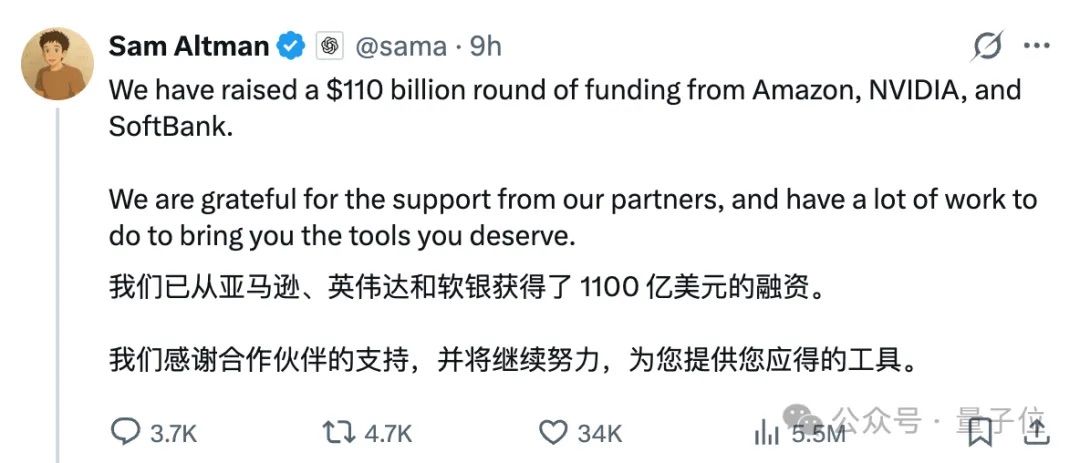
Officially, the funds will be used to expand artificial intelligence infrastructure construction, accelerating the democratization of AI.
Sam Altman outlined the specific areas of cooperation with the three partners on X:
- Nvidia: Responsible for providing underlying computing power, offering continuous and scalable training and inference capabilities for OpenAI centered around GPUs and next-generation accelerators;
- Amazon: Providing cloud infrastructure and global deployment capabilities to support OpenAI’s model delivery and commercialization across multiple regions and industry scenarios;
- SoftBank: Assuming a capital and ecosystem role, driving OpenAI’s expansion into broader industrial systems through long-term financial support and the integration of industry resources.
Additionally, as an existing shareholder, Microsoft did not miss out.
The two parties released a joint statement confirming that their previous cooperation remains unaffected. Microsoft Azure will remain the exclusive cloud service provider for OpenAI APIs, and Microsoft retains exclusive licensing and access rights to the intellectual property within OpenAI’s models and products.

At the same time, three of the most critical AI resource lines—upstream computing power, cloud infrastructure, and long-term capital—have been tied together in one go.
One Financing Round Covers Three Giants
In this round of financing, Amazon was the most generous investor, contributing $50 billion.
The investment will be made in stages: Amazon will initially invest $15 billion, with an additional $35 billion to follow within the next few months once specific conditions are met.
Regarding these “specific conditions,” insiders suggest they involve OpenAI “achieving AGI” or a successful IPO.
Furthermore, there is a special clause in the agreement between OpenAI and Microsoft: once AGI is achieved, Microsoft will lose access to its technology.
Under this new agreement, OpenAI plans to develop a new “stateful runtime environment” where its models will run on Amazon’s Bedrock platform.
OpenAI has committed to consuming large-scale cloud computing resources on the AWS platform, including approximately 2 gigawatts of Trainium chip compute power, to support Frontier, stateful environments, and other advanced workloads.
Additionally, both parties will expand upon the $38 billion agreement signed last November. Over the next eight years, OpenAI plans to consume cumulative cloud computing resources worth approximately $100 billion on AWS.
Amazon CEO Andy Jassy stated, “Today, the world’s two largest AI labs are heavily utilizing Trainium.” Besides OpenAI, the other is Anthropic.
Previously, Amazon had invested billions of dollars into Anthropic and built an $11 billion data center campus in Indiana specifically for training and running Anthropic’s models, known as the “Project Rainier.”
However, Amazon also clarified that its cooperation with OpenAI would not alter its relationship with Anthropic.
The second investor is Nvidia.
In September last year, rumors circulated that Nvidia would invest $100 billion in OpenAI. However, subsequent reports suggested the investment amount might be smaller.
At the time, Jensen Huang (Jensen “Old Huang”) specifically debunked claims that Nvidia was abandoning OpenAI:
We are putting a lot of money in; I believe in OpenAI. The work they are doing is incredible.
And just like that, $30 billion arrived.
Under this agreement, OpenAI commits to using 2 gigawatts of training capacity on Nvidia’s Vera Rubin system, plus an additional 3 gigawatts of compute resources (likely in the form of GPUs) for specific AI inference tasks.
In other words, Nvidia serves as both a strategic investor and its chip supplier, effectively paying OpenAI to buy its own chips—a logic of “circular investment.”
The third investor is SoftBank, contributing $30 billion.
Official announcements indicate that SoftBank’s investment will be disbursed in three installments in April, July, and October 2026.

SoftBank Group Chairman and CEO Masayoshi Son expressed confidence in OpenAI’s continued growth:
Through this additional investment, we will accelerate OpenAI’s research and ecosystem expansion while advancing our own AI strategy.
Notably, some media outlets suggest SoftBank plays not only the role of an investor but also a “matchmaker.”
Insiders indicate that OpenAI is expected to secure approximately $10 billion in primary equity financing, with related commitments to be finalized within the next month. Investors include sovereign wealth funds and investment firms. It is speculated that these investors may connect through SoftBank.
Microsoft Relationship Remains Intact, But Diversification Sought
Next, let’s discuss OpenAI’s existing shareholder, Microsoft.
Microsoft has been one of OpenAI’s largest supporters and its exclusive infrastructure partner. Following the announcement of this financing round, despite widespread speculation, OpenAI and Microsoft strongly maintained their partners’ “core status” in their latest statement:
- Exclusive Status of Azure: Microsoft Azure remains the exclusive cloud service provider for OpenAI’s stateless APIs. OpenAI’s first-party products (including Frontier) will continue to be hosted on Azure;
- Unchanged Commercial Logic and Revenue Sharing: The existing revenue-sharing agreement remains in effect. Even if OpenAI generates revenue on Amazon or Oracle clouds, Microsoft will still receive a “cut”;
- Exclusive Intellectual Property Rights: Microsoft continues to hold exclusive licensing rights to the intellectual property of OpenAI’s existing models and future products.
However, this financing round also serves as proof that OpenAI is seeking to transcend its long-standing relationship with Microsoft and diversify its business.
Amazon’s entry is the best example. As a major competitor to Microsoft in cloud computing, Amazon’s inclusion—alongside OpenAI’s commitment to an additional $100 billion in AWS consumption over eight years and large-scale adoption of Amazon’s self-developed Trainium 3/4 chips—indicates that OpenAI is unwilling to put all its compute eggs in the Azure basket.
One More Thing
By now, readers may have realized this is another typical “circular financing” logic.
Nvidia is both a shareholder and the sole supplier of underlying computing power (“the arms dealer”); Amazon is both a new investor and OpenAI’s future cloud service provider.
Simply put, suppliers (Nvidia/Amazon) invest money into their customer (OpenAI), who then uses that money to buy chips or cloud services from those same suppliers. For the suppliers, this money shifts on their balance sheets from “investment expenditure” to “operating revenue,” boosting stock prices and locking in future market share.
It’s a win-win situation.
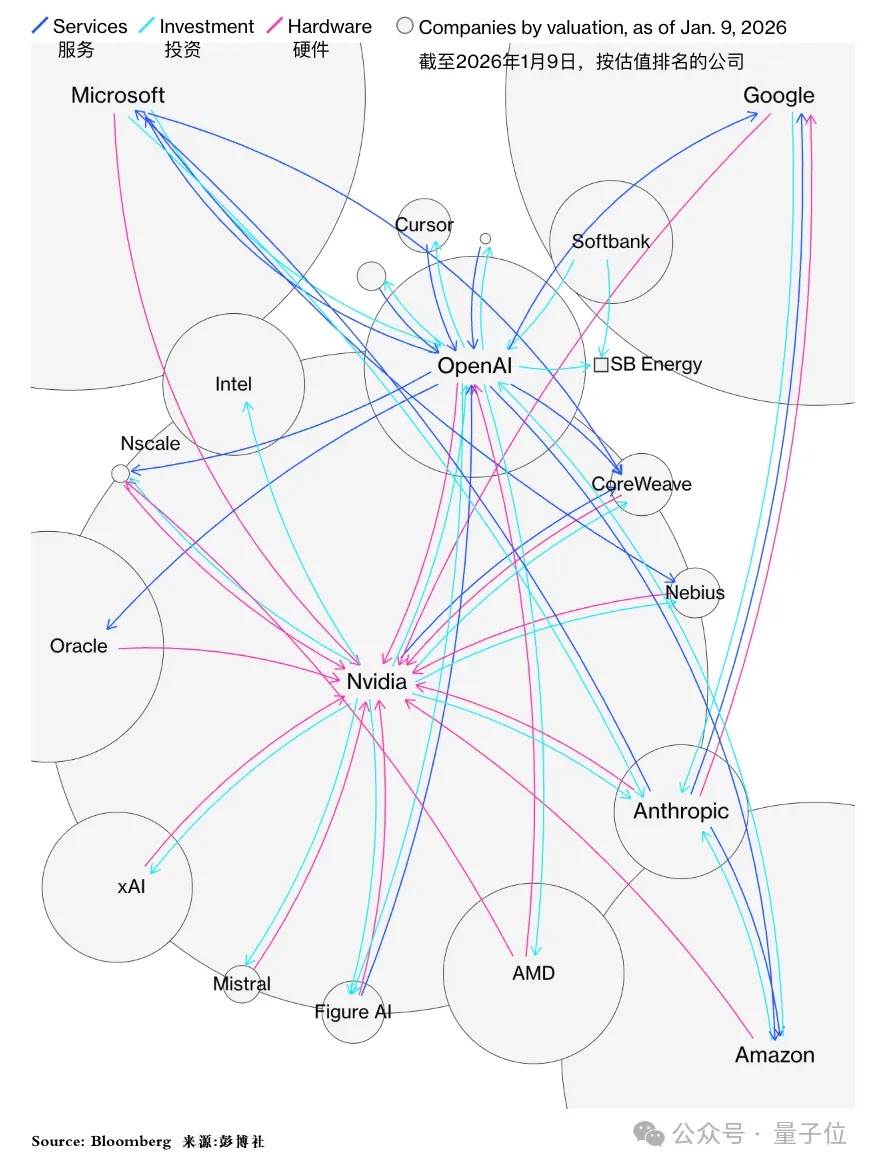
Although there are concerns about this narrative of “circular financing,” Altman stated:
I understand everyone’s concerns; this only makes sense when new revenue flows into the entire AI ecosystem.
OpenAI’s previous financing round was completed in March 2025, raising $40 billion and valuing the company at $300 billion. At that time, it was the largest private equity financing deal in history.
With this new round of financing added to its existing cash reserves of approximately $40 billion, OpenAI’s available funds will increase to approximately $150 billion. The company expects to achieve positive free cash flow for the first time only by 2030.
OpenAI indeed needs these funds and compute resources. Data from February shows that ChatGPT’s weekly active users have surpassed 900 million, with monthly visits reaching approximately 57.2 billion. There are over 50 million individual subscribers and more than 15,000 active enterprise customers.
Altman also stated that he is dedicating significant effort to securing additional compute capacity to meet the demand for ChatGPT and other OpenAI products.
Competition among top AI laboratories remains fierce. Recently, rival Anthropic secured $30 billion in funding from investors including Microsoft and Nvidia, pushing its post-money valuation toward $380 billion and enhancing its ability to compete with OpenAI.
Now that the ammunition is loaded, we will see what surprising new models OpenAI brings to the table with this massive influx of capital.
References
2027386252555919386. 2027386252555919386 — x.com/sama/status/2027386252555919386