Shocking Breaking News: OpenAI Has Just Shut Down Sora!
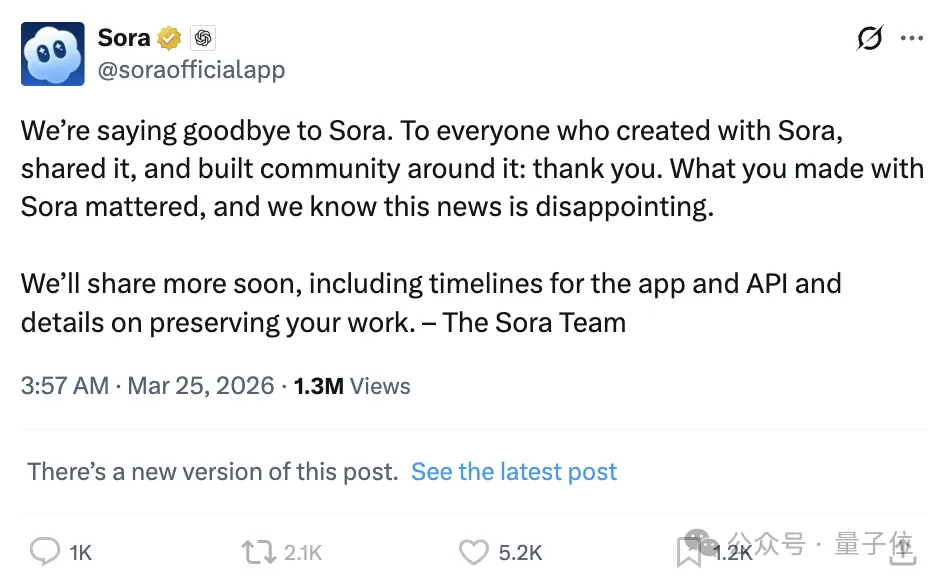
The Sora team released a statement:
We are saying goodbye to Sora.
Thank you to every user who created, shared works, and built communities around Sora: Everything you have created with Sora is meaningful, and we understand that this news will be disappointing.
We will announce more details as soon as possible, including the timeline for shutting down the app and API, as well as plans for retaining user-generated content.
The news sent X into a frenzy, with users expressing utter disbelief:
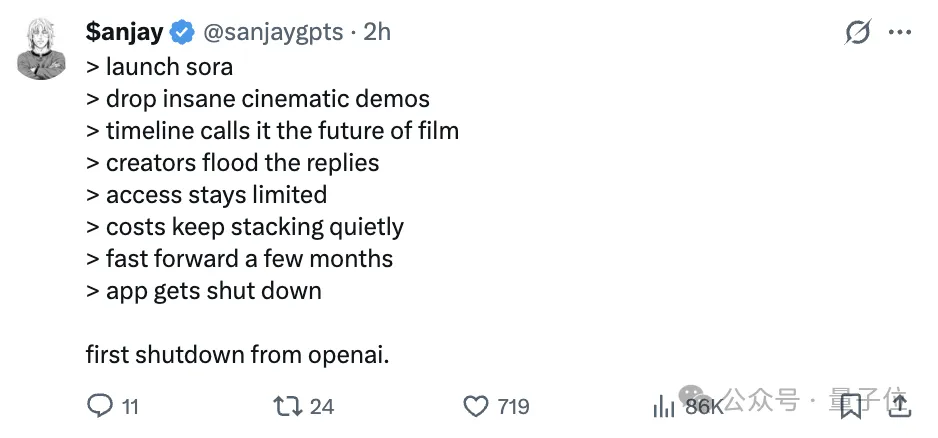
If public-facing products launched by OpenAI are abruptly shut down just months later, why should we trust or invest in such products?

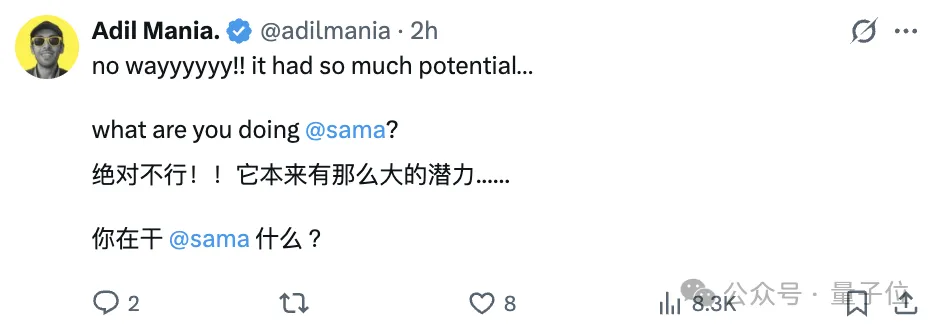
Netizens flooded the platform tagging Sam Altman, demanding to know what was going on.
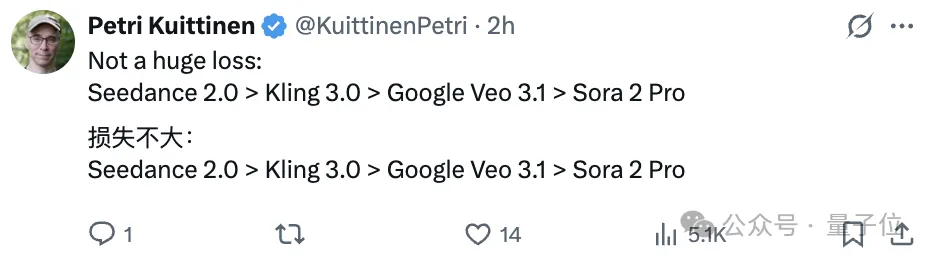
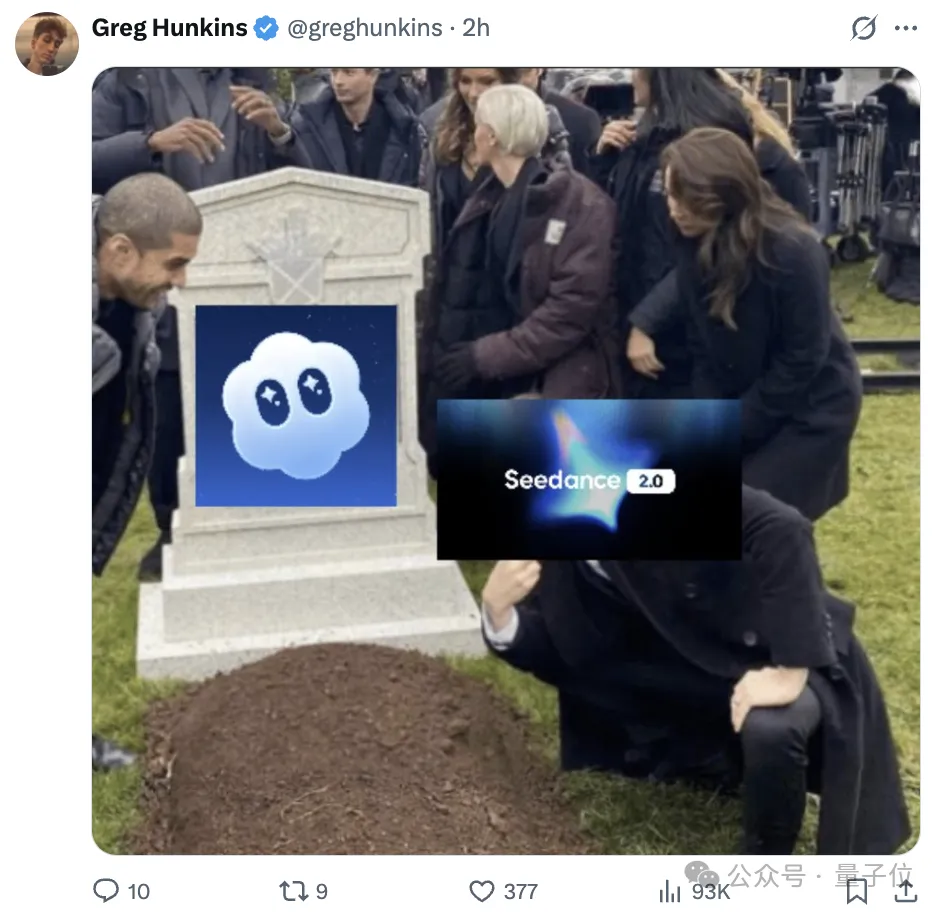
However, some users remained calm, noting that they still have access to other excellent models like Seedance 2.0 and Kling 3.0.
Notably, just three months ago, OpenAI had secured a three-year licensing agreement with Disney.
Sora was originally set to generate videos based on over 200 IPs from Disney, Marvel, Pixar, and Star Wars.
Furthermore, under the original plan, Sora’s image-to-video capabilities integrated with ChatGPT were scheduled to launch “fan-inspired” themed videos this year, and a selection of Sora-generated videos was set to debut on Disney+‘s streaming platform.
Now that the Sora project has been terminated, Disney has announced the termination of all cooperation with OpenAI, including plans to invest $1 billion in acquiring shares of OpenAI.
A Disney spokesperson told Variety:
The AI industry is still in its early stages and evolving rapidly. We respect OpenAI’s decision to exit the video generation business and shift its strategic focus to other areas. We appreciate the constructive collaboration between our teams and the valuable experience gained during this partnership. In the future, we will continue to collaborate with various AI platforms to explore new ways to reach fans, while responsibly leveraging new technologies and respecting intellectual property rights and creators’ legitimate interests.
Sora: From Hype to Obsolescence
Looking back at Sora’s journey from explosive popularity to its abrupt end, it was a classic case of high expectations followed by a steep decline.
In February 2024, OpenAI made a grand debut with the Sora technical preview, sparking industry-wide attention due to its realistic physics and scene reconstruction capabilities.
CEO Sam Altman subsequently used social media platforms to continuously showcase generation results, further inflating market expectations.
In December 2024, the first-generation Sora officially launched, initially available to users in the US and Canada as an exclusive feature for ChatGPT Plus/Pro subscribers, supporting core text-to-video and image-to-video functions.
In September 2025, Sora 2 was officially released, featuring comprehensive upgrades in physical accuracy, realism, and controllability. It added synchronized audio-visual output and dialogue generation capabilities, alongside a standalone iOS social app that supported storyboard creation, seamless video blending, and direct text-to-video editing. It was hailed as “the GPT-3.5 moment for the video industry.”
Following its launch, Sora 2 maintained its hot momentum, quickly topping the free charts on the US App Store. Invitation codes in the secondary market were even speculated to be sold at high prices.
However, this good fortune did not last long. As domestic Chinese video large models achieved technological breakthroughs and caught up in generation quality, Sora’s popularity began to recede.
At the same time, copyright crises surrounding Sora continued to escalate. In November 2025, CODA, an industry association composed of Japanese content companies including Studio Ghibli, wrote to OpenAI demanding that it stop using their content to train Sora 2.
Even earlier this year, when OpenAI reached a three-year licensing agreement with Disney and finalized a $1 billion investment plan from Disney—opening up over 200 IP characters for Sora’s use—no one could have predicted that this once-glorious AI video product would end in such a rushed shutdown.
Why Did OpenAI Make This Decision?
So, what exactly is going on?
According to The Wall Street Journal, this move is part of a series of strategic adjustments by OpenAI.
Everything is being prepared for the company’s initial public offering (IPO), which is expected to launch as early as the fourth quarter of this year. The company is refocusing its business priorities on commercial and code development-related features.
CEO Sam Altman announced these changes to employees on Tuesday, stating that the company would gradually discontinue products based on its video models.
In addition to shutting down client applications for general users, OpenAI simultaneously terminated services for developer versions of Sora and will no longer provide technical support for video functions within ChatGPT.
Currently, OpenAI is in a phase of strategic transformation, planning to redirect its computing resources and core technology teams toward developing productivity tools for enterprise and individual users.
Last week, OpenAI announced the integration of its ChatGPT desktop application, code development tool Codex, and browser into a single “super app.” The company hopes this consolidated product will enable all employees to work toward unified development goals.
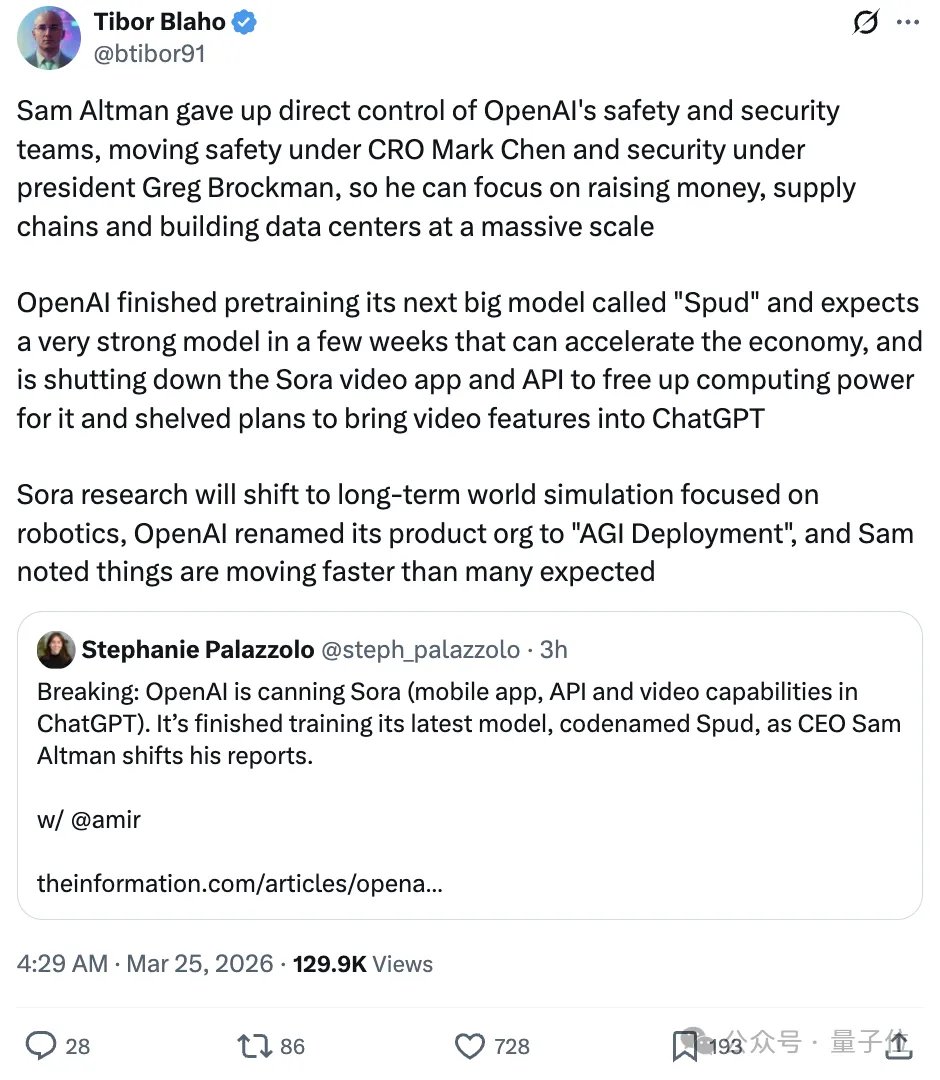
Additionally, rumors from netizens suggest that Sam Altman is no longer directly managing OpenAI’s safety team, choosing instead to focus more on fundraising, supply chain management, and the construction of large-scale data centers:
OpenAI has completed pre-training for its next-generation large model, “Spud,” with a powerful new model expected to launch within weeks. It was precisely to free up computing resources for this new model that OpenAI decided to shut down Sora and shelve plans to integrate video functions into ChatGPT.
As for R&D work related to Sora, it will shift focus toward long-term world simulation research centered on robotics technology. OpenAI has renamed its product division to “AGI Deployment.”
AI Video Is Entering “China Time”
Sora’s retreat does not mean that AI-generated video is facing a dead end.
Increasingly, achievements and practices are proving that, like many innovations requiring specific scenarios and ecosystems, AI video generation is entering “China Time.”
This AI innovation race ignited by Sora during the 2024 Spring Festival now shows strong momentum driven primarily by Chinese faces and players.
This holds true across technology, business models, and ecosystem tiers.
On the technological front, the ceiling has been reshaped, with ByteDance claiming the new high ground. Around the 2026 Spring Festival, following the release of Seedance 2.0, its extreme restoration of complex physical laws (such as fluid dynamics and fabric wrinkles) and human micro-expressions triggered seismic reactions and heated discussions on social media.
Results are the best proof of technology. With Seedance 2.0, ByteDance has proven itself to be a competitor with the strength to directly challenge OpenAI and Google in the AI video field and even broader multimodal and AI R&D sectors.
In terms of commercial closed-loop models, Kuaishou’s Kling is the global number one player in AI video.
After Sora’s successful demos, Kling proved that AI video can be a genuine money-printing machine for growth.
According to the latest financial report data, as of December 2025, Kling AI’s monthly revenue exceeded $20 million (approximately 140 million RMB), with its annualized run-rate (ARR) soaring to $240 million. More persuasively is its user stickiness: over 60 million global creators have cumulatively generated more than 600 million videos.
This endogenous drive of “massive user feedback—model iteration—commercial monetization” is a necessary condition for the AI video flywheel from technology to commercial closure; the snowball of innovation has already been set in motion.
Finally, at the ecosystem level, unlike the oligopoly seen in Silicon Valley’s AI video sector, China’s ecosystem is experiencing tiered explosive growth.
Beyond ByteDance and Kuaishou, emerging forces are demonstrating technological and capital competitiveness at an unprecedented pace.
Kunlun Tech not only refreshed global authoritative rankings with new models but also achieved a switch in AI engine momentum in actual business implementation.
Startup unicorns like Shengshu (Tongyi Wanxiang) demonstrate high levels of technical model innovation, while PixVerse (Aishi) showcases strong capital appeal—both are the best proofs of China’s scenario dividends.
What is the “China Scenario Dividend”?
Because China possesses the world’s most dense short-video, e-commerce, and micro-drama industry chains, this serves not only as a rich data mine but also as a natural “flywheel training ground.”
Therefore, even if Sora launched a dedicated app in Silicon Valley or the US, it is difficult for it to achieve a faster flywheel closed-loop compared to the Chinese scenario.
The innovation race for AI video may have just begun, but undoubtedly, along this main timeline of progress, China has shifted from being a follower to becoming a core pillar and leading force.
After Sora’s retreat, Chinese players are stirring up waves—
A picturesque landscape.
References
2036532795984715896. 2036532795984715896 — x.com/soraofficialapp/status/2036532795984715896 2036540895986602266. 2036540895986602266 — x.com/btibor91/status/2036540895986602266