At this year’s GTC conference, Jensen Huang announced that NVIDIA is no longer limited to being a chip or GPU company, but has fully transformed into a full-stack AI infrastructure provider.
This places “AI Infrastructure” back at the center of industry attention.
In fact, long before this trend emerged, Wuyuan Xinqiong (Wuqian), a leading player in China’s AGI infrastructure sector, had already established itself by laying the groundwork for AI’s underlying infrastructure. Evolving through successive waves of industry change, it has set a benchmark for the development of China’s AI infrastructure.
Today, its services, including token production, are embedded in the foundation of top-tier models such as Kimi, GLM, MiniMax, and DeepSeek—meaning almost everyone who has used domestic large language models has indirectly utilized its services.
Recently, the company announced it had secured an additional round of financing exceeding 700 million RMB.
This funding scale firmly places Wuqian in the first tier of China’s AI-native infrastructure enterprises and identifies it as one of the most rapidly growing new entrants in the underlying AI track.
However, compared to its financing achievements, its business growth data more intuitively reflects its industry position.
Public data shows that by the end of April 2026, Wuqian’s MaaS (Model-as-a-Service) platform saw daily token call volumes increase by over 20 times compared to the end of 2025. This growth rate is dozens of times higher than the national average; since late January, the platform’s token call volume has doubled every two weeks.
In the AI 2.0 era, Wuqian has focused exclusively on the AGI infrastructure track. In just three years, it has continuously secured nearly 2.2 billion RMB in funding from top-tier investors.
That is not all. Wuqian has now become an essential partner for many of China’s leading large models.
All answers point to the token economy wave currently sweeping through the entire AI industry.
Understanding this industrial transformation allows us to grasp the core value of this hub within the token economy.
The Token Economy Wave Has Arrived
Capital markets always have a sharper sense of smell than industrial implementation.
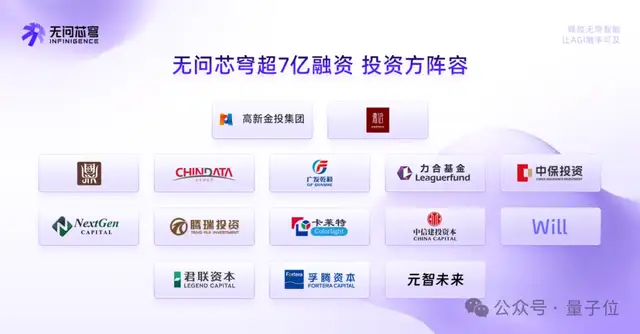
The lead investors in Wuqian’s latest round are Hangzhou High-Tech Investment Group and Huiyuan Capital, with co-investors including Guoxing Capital, Qinhai Data, GF Qianhe, Lihai Qingtong, Zhongbao Investment, AEF NextGen, Tengrui Capital, Kalait, CITIC Construction Capital, and Kuande Intelligent Learning Laboratory (Will). Existing shareholders Junlian Capital, Shanghai State-owned Assets Futeng, and Yuanzhi Future also increased their investments.
Covering government industrial capital, PE institutions, data centers, finance, manufacturing, and other real economy sectors, this lineup is highly cross-disciplinary, breaking the traditional pattern where early AI investment was heavily concentrated in the tech circle.
Today, whether it is industrial capital or real-economy enterprises, a unified consensus has formed:
AGI infrastructure is the core foundation of the future AI industry. Early layout in underlying infrastructure means capturing the core dividends of AI industrialization.
The core background for this consensus is that the AI industry has entered a brand-new stage of Agent development, with new-era scenarios imposing disruptive new demands on underlying infrastructure.
Older underlying architectures designed for traditional conversational large models can no longer keep up with the pace of the new era. The comprehensive implementation of Agent scenarios imposes disruptive requirements on the computing power, latency, and stability of AI infrastructure.
The industry’s underlying infrastructure faces three major disruptions due to the arrival of the Agent era.
First, Agents transform large models from “chat bots” into “digital workers who get things done.”
Before the advent of the Agent era, large models were more like amateur chat partners.
Most public use of large models involved simple Q&A, copywriting polishing, or basic consulting, with token consumption per interaction limited to hundreds, placing negligible pressure on computing power.
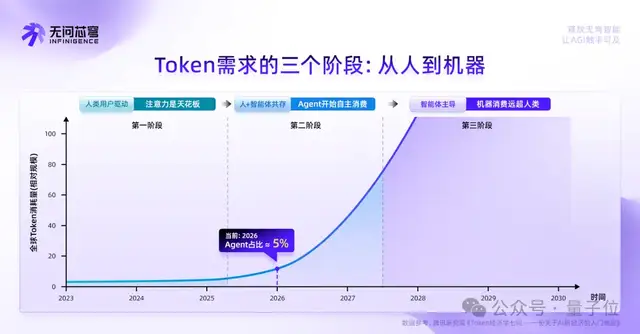
However, the popularity of Agents like OpenClaw has directly triggered an identity transformation for large models.
They have evolved into full-time digital workers capable of autonomous planning, execution, and review.
Complex long-chain tasks and multi-step collaborative work have become the norm, with token consumption per Agent task soaring to levels of 100,000 or even a million.
This has led to an outpouring of massive computing power demand, exacerbating the existing shortage of supply in China’s computing market.
In addition to the geometric growth in computing consumption, the upgrade in interaction rhythm has severely exposed the shortcomings of traditional AI infrastructure.
This is the second disruption brought by the Agent era.
Traditional human-computer dialogue rhythms are slow. Users manually input queries and ask questions round-by-round, tolerating intervals measured in minutes, making hundreds-of-milliseconds startup latency negligible.
Agent work modes are completely different.
High-frequency linkage between intelligent agents, real-time decision-making, and uninterrupted iteration compress the interaction rhythm to the millisecond level.
The latency shortcomings of traditional architectures are infinitely magnified, becoming a key bottleneck restricting the large-scale implementation of Agents.
An even stricter change, representing the third disruption of the Agent era, lies in the requirements for task stability.
Traditional large model interactions involve short-term, single operations; starting and stopping at any time or occasional errors do not significantly impact the overall experience.
In contrast, Agents focus on long-duration continuous work. The industry’s mainstream GLM5.1 model, supported by professional infrastructure, can achieve a single continuous operation of 8 hours.
This mode of long-term, high-load, zero-interruption operation poses a severe test for computing scheduling precision, system stability, and fault tolerance capabilities. Traditional infrastructure is already unable to meet the demands of such high-end scenarios.

The direct result of these three disruptions is an explosion in token call volumes.
Data released by the National Bureau of Statistics shows that daily national token call volumes have exceeded 140 trillion, representing a year-on-year increase of over 40%. The entire industry has officially entered a high-growth dividend cycle.
While the overall industry market rises, the growth of leading platforms is leaving others far behind.
By the end of April 2026, Wuqian’s daily token call volume had surged more than 20 times compared to the end of 2025, with a growth rate surpassing the national average, fully demonstrating the capacity and adaptability of leading infrastructure platforms.
Xia Lixue, Co-founder and CEO of Wuqian, remarked at the Zhongguancun Forum in March that the last time he witnessed such crazy growth curves was “during the era when mobile data usage exploded among all smartphone users in the 3G era.”
The traffic explosion back then supported the golden decade of the entire mobile internet.
Today, the exponential growth in token call volumes signals that the AI industry is about to exit the conceptual phase and enter a new stage of comprehensive implementation and universal adoption.
Massive incremental demand is flooding into the market, creating an urgent need for professional, stable, and efficient underlying platforms to handle this wave.
For this reason, leading domestic large model enterprises are partnering with third-party infrastructure providers to jointly build new underlying support systems adapted to the Agent era.
The Token Economy Hub Behind Top-Tier Domestic Models
Why is an independent third-party MaaS platform necessary?
To date, the division of labor in AI industry development has become highly refined and specialized.
Just as Apple, Qualcomm, and AMD rely on TSMC, all model manufacturers require efficient inference computing power and a trustworthy independent third-party platform.
The AI industry follows the rule that professionals do professional work: model companies focus on algorithms and scenarios, while underlying computing optimization and token production are handed over to specialized third-party MaaS platforms for implementation.
However, the current infrastructure landscape is naturally divided into three segments, each with inherent attributes.
For example, big tech’s infrastructure primarily serves internal businesses; chip manufacturers’ infrastructure binds hardware ecosystems. Neither can achieve fair openness across the entire industry. Meanwhile, model companies building their own infrastructure are restricted by competitive relationships and cannot serve as a universal foundation for the whole industry.

In this industry landscape, only neutrality can make Wuqian the greatest common divisor of China’s AI industrial chain; only by becoming that greatest common divisor can it grow into the core hub of the token economy.
Wuqian’s differentiation lies in its All-in Infra strategy based on neutrality.
Currently, relying on its Agentic MaaS platform, Wuqian provides high-performance service optimization for mainstream domestic open-source models such as GLM, Kimi, MiniMax, DeepSeek, and Tongyi Qianwen. It achieves a precision alignment rate of >99.9%, increases throughput by 2-3 times, reduces overall latency by 50%, compresses first-token latency to within 500ms, and ensures enterprise-grade high availability of 99.95%.
This extreme focus has made it the default choice for leading model manufacturers during the token explosion period, gradually growing into the core hub of token economy circulation.
Yes, the deeper era proposition we face now is that the focus of AI industry competition is shifting from model capabilities to token production efficiency.
Whoever can complete token production and scheduling at lower cost, higher efficiency, and greater stability will hold the core discourse power in AI industrialization.

Regarding these issues, let’s look at Wuqian’s preparation status.
First, dynamic upgrades.
The company has comprehensively upgraded its Agentic Infra technology system to specifically adapt to the exclusive operational needs of Agent intelligent entities. It precisely solves industry pain points such as high latency, poor stability, and insufficient concurrency capacity in traditional architectures, perfectly matching new-generation industrial scenarios characterized by millisecond-level interactions, long-duration task execution, and high-concurrency calls.
Wuqian has also keenly captured the trend toward multi-agent collaboration and end-to-end implementation, pioneering the construction of a next-generation Agentic Infra capable of autonomous evolution through proprietary AI technology. Relying on an enterprise-grade intelligent agent service platform, it provides solutions for different industry scenarios.
Second, launching over 100 out-of-the-box large models with deep high-performance optimization of domestic frontier models.
As of April 2026, the Wuqian Agentic MaaS platform has launched more than 160 large models, all supporting plug-and-play usage, significantly lowering the entry threshold for enterprises and developers.
The platform keeps pace with open-source model updates, enabling Day 0 rapid adaptation and listing for newly released open-source models. Simultaneously, it has completed deep high-performance optimizations for mainstream domestic models such as Kimi, Zhipu, DeepSeek, Tongyi Qianwen, and MiniMax, maximizing the core performance of every model.
Solid technical capabilities have also garnered top-tier industry endorsements.
In February 2025, MIT Technology Review published an article titled “Four Chinese AI Startups to Watch Beyond DeepSeek,” noting that beyond DeepSeek, four other Chinese AI enterprises—Wuqian, StepFun, ModelBest, and Zhipu AI—also demonstrated impressive technical strength and global competitiveness.
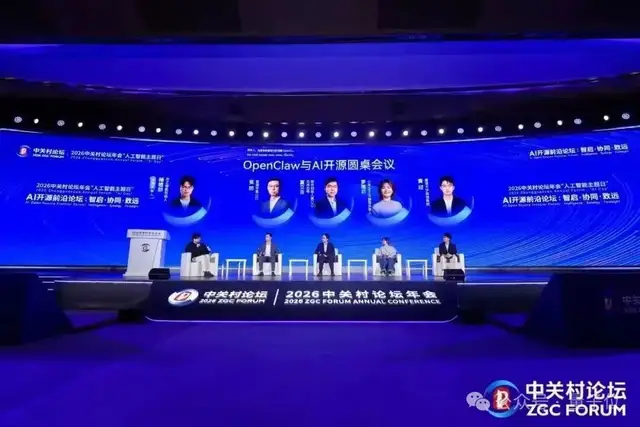
At the Zhongguancun Forum in March 2026, Xia Lixue, Co-founder and CEO of Wuqian, shared a stage with Kimi founder Yang Zhilin and Zhipu AI CEO Zhang Peng, revealing Wuqian’s practices and reflections as the infrastructure and token service provider for many leading large model enterprises like Kimi and Zhipu in this round of AI transformation.
Kimi excels in deep understanding of long texts, while Zhipu GLM focuses on processing general complex tasks; both are benchmark players in the domestic large model track.
In addition, Wuqian’s cooperation portfolio covers a host of top-tier domestic models including DeepSeek, MiniMax, and Tongyi Qianwen, essentially encompassing all mainstream high-quality domestic model resources.
If each large model is likened to an independent power plant in the AI era, continuously producing intelligent service capabilities, then Wuqian is the super grid connecting all these plants.
It is responsible for integrating scattered computing resources across the network, efficiently completing token production and scheduling, and stably delivering AI productivity to thousands of industries and billions of terminals.
This deep cooperative relationship has also brought about a fascinating effect of synchronized growth—while call volumes for leading models like MiniMax and Zhipu have surged dozens of times, Wuqian’s token call volume has simultaneously achieved explosive growth.
It does not face C-end users directly, yet it supports the operation of the vast majority of AI applications across the network.
Wuqian has long been deeply rooted in China’s core AI production chain, becoming an indispensable core node in the token circulation network.
…, firmly establishing itself as the “water and electricity” of the AI industry, silently supporting the high-speed operation of the entire sector. **
It has clearly become a hub for the Token economy in practice.
China’s Water Sellers in the Token Economy
Following the official announcement of its new round of financing, Wuwen Xinqiong released a new logic for AI productivity, introducing for the first time an “AI Productivity Formula”:
AI Productivity = Intelligent Scale × Token Production Efficiency × Token Value Conversion.
Breaking down this formula layer by layer makes it easier to understand:
- Intelligent Scale = The scale of diverse and heterogeneous computing power that can be optimized through technology.
- Token Production Efficiency = The ability to efficiently convert electricity into Tokens (Tokens/s).
- Token Value Conversion = The ability to efficiently convert Tokens into productivity for the entire society (Productivity/Token).
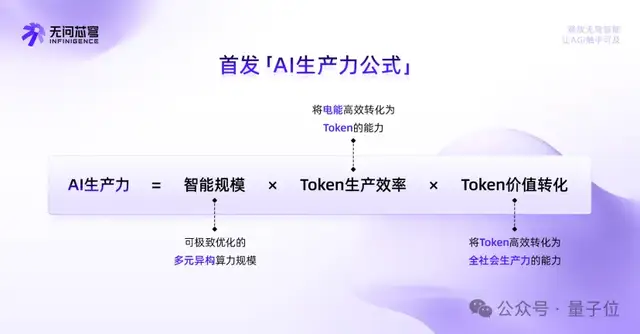
This formula breaks through public preconceptions about Tokens.
In the past, a Token was merely a technical unit of measurement used to track model interaction consumption.
This new formula directly upgrades the Token into a core economic variable driving AI industry development, clearly delineating the complete closed-loop logic for AI industrialization and value realization.
Prior to this, Wuwen Xinqiong had already proposed a clear value conversion logic: Input → Electricity → Tokens → Productivity → Value.
The core breakthroughs in this entire industrial closed loop focus on two areas.
First, the efficiency of converting electricity into Tokens tests the underlying hard power of infrastructure scheduling, energy utilization, and cost control.
Second, the efficiency of converting Tokens into actual productivity relies on model adaptation, scenario implementation, and industry empowerment capabilities to realize value.
China possesses unique advantages for developing a Token economy.
A plentiful and stable energy structure provides a solid foundation for large-scale computing operations, while the world’s most complete AI industrial chain and largest AI application consumer market… all of this gives China’s AI sector the full capability to replicate the rise path of “Made in China.”
Over the past few decades, Chinese manufacturing has relied on its comprehensive industrial system to become the global center for commodity supply, underpinning rapid economic growth.
In the future AI era, AI empowering the real economy will become a new growth engine. Relying on technological and industrial advantages, “AI Made in China” will participate in global AI industry competition in the novel form of Token output.
If we view the export of Tokens from “AI-Made in China” as a new engine, then Wuwen Xinqiong’s long-term goal as a Token economy hub becomes clear and reasonable.
Wuwen Xinqiong’s long-term goal is to build a high-energy-efficiency Token smart factory within China.
By fully activating domestic energy and industrial advantages, it will transform premium computing power into standardized, high-quality Token products, providing stable and efficient underlying services for global developers and enterprises. This will help the domestic AI industry move from scenario implementation to a new stage of value exportation.
Recently, valuation trends in the capital market have indirectly confirmed the immense potential of the Token infrastructure track.
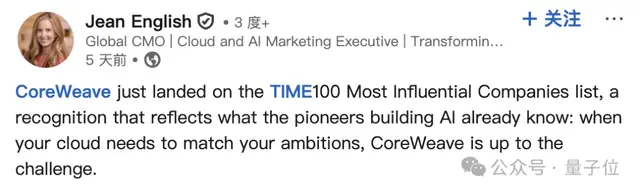
After overseas leading AI computing service provider CoreWeave completed its IPO, its market cap soared from $23 billion at launch to $66 billion, an increase of 189%.
This company’s core business is providing computing power support and Token services for top-tier overseas AI models. Its business model and track positioning are highly aligned with Wuwen Xinqiong.
The surge in valuations in overseas capital markets means that global capital has recognized the core value of Token infrastructure, and the industry’s overall valuation system has been reconstructed.
The direction of domestic capital is also changing synchronously.
Investors in Wuwen Xinqiong’s current financing round are no longer limited to traditional tech investment institutions; a large number of government industrial funds, financial institutions, and real manufacturing enterprises have entered the fray.
This cross-boundary diffusion within the investment circle indicates that the value of the Token economy has stepped out of the tech sector, gaining comprehensive recognition from the real economy and industrial capital.
In summary, Wuwen Xinqiong occupies a golden track position in China’s AI industry; calling it a hub for the Token economy is no exaggeration.
Its unique positioning as a neutral third party creates irreplaceable industrial value; the exponential explosion of Token demand endows the company with strong long-term growth potential; and its mature productivity formula and complete industrial closed loop provide a clear development path for continuous iteration.
In the wave of comprehensive AI industrialization, Wuwen Xinqiong steadily plays the key role of an industry “water seller,” safeguarding the intelligent transformation of the entire sector.
Looking back at the development history of the mobile internet, the traffic explosion in the 3G era gave rise to mass-market applications such as short videos, mobile payments, and local life services, completely reconstructing public life and industrial forms.
Today, the Token explosion in the AI industry is replicating that past traffic miracle.
Wuwen Xinqiong, which raised 2.2 billion yuan over three years, stands out as the best example of this era’s distinct archetype.