Just now, a financing round by an AI company sparked intense discussion within the industry.
Why? Because it is closely tied to embodied intelligence and inextricably linked to the world models that pave the way for physical AI. More precisely, the company that just completed its funding stands as a key supplier in the ecosystem connecting these two domains: a simulation-based synthetic data provider.
This website has learned that Guanglun Intelligence (Lunaria), a simulation synthetic data company, has just completed Series A and A+ financing rounds totaling hundreds of millions of yuan.
The disclosed investors include institutional players such as Orient Fortune Capital and Jiupai Capital, as well as industrial stakeholders like 37 Interactive Entertainment and Amber Capital. Existing shareholder Chentao Capital has also continued to increase its stake.
Equally noteworthy are its client roster, which includes Nvidia, Google, Alibaba, ByteDance, Figure AI, 1X Technology, Zhiyuan Robotics, Galbot, Toyota, Bosch, BYD, Geely, and more.
It single-handedly connects the entire AI ecosystem.
Rumors suggest that this company, the only global firm specializing in simulation synthetic data, has already broken through the 100 million yuan revenue mark.
As the world’s first company to integrate generative AI into simulation technology, Guanglun Intelligence was founded by Xie Chen, a prominent figure in the industry who previously served as the head of simulation at Nvidia, Cruise, and NIO.
Its recent breakout moment came from its inaugural interview with Madison Huang, daughter of Nvidia CEO Jensen Huang, discussing physical AI—the current hot topic.
Physical AI is the trend ignited by Jensen Huang earlier in 2025, but within just a year, inflection points for this trend are being continuously validated.
Guanglun Intelligence stands at this inflection point, which is the core reason it has attracted attention and optimism.
Why is it so promising? Because the trend inflection point has truly arrived.
The AI wave is spreading from the information domain into physical reality.
However, when entering scenarios that require interaction with the physical world—such as manipulating objects, completing tasks, or adapting to changing environments—existing AI systems still exhibit significant shortcomings.
As AI pioneer Fei-Fei Li pointed out in her widely discussed essay From Words to Worlds: Human understanding of the world goes beyond seeing what is right in front of us; it involves comprehending spatial relationships, semantic meanings, and real-world significance.
This capability of “spatial intelligence” is the core breakthrough for AI’s next phase.
This also explains why global research and industry sectors are currently focusing their attention on world models and embodied intelligence—they are the key pathways to breaking down the barriers between AI and the physical world.
Because both directions point toward the same goal: enabling models to interact with the physical world.
Training world models and embodied intelligence models no longer requires image-text alignment or language-labeled data, but rather multimodal interaction process data. Such data must possess characteristics of scalability, structure, and strong controllability.
The industry-standard data pyramid categorizes training data into three types:
- Real-world teleoperation data
- Simulation synthetic data
- Human video data
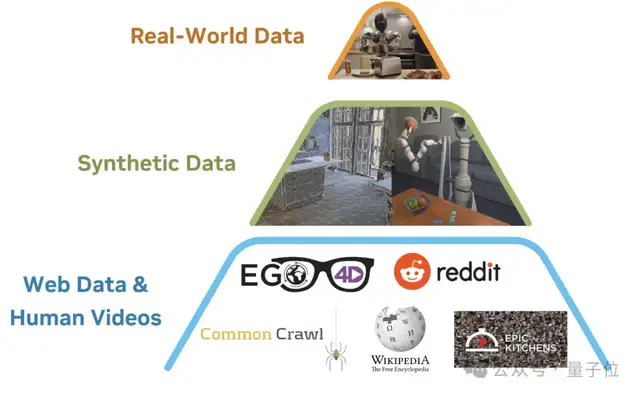
Among these, simulation synthetic data and human video data are considered “model-agnostic data,” making them easier to standardize and generate at scale.
Between the two, simulation synthetic data has clearer structure, higher precision, stronger controllability, and a higher ROI (Return on Investment).
In the field of embodied intelligence, training both the “cerebellum” and “cerebrum” models for robots requires large amounts of simulation synthetic data. Especially for cerebellum models, which have an even higher dependence on high-fidelity simulation synthetic data.
One aspect often overlooked is that world models also have a strong demand for simulation synthetic data.
As Fei-Fe Li emphasized in From Words to Worlds:
(For training world models), the role of high-quality synthetic data and additional modalities (such as depth, touch) cannot be underestimated; they play a supplementary role during key stages of the training process.
Moreover, compared to embodied VLA foundation models deployed on edge devices, world models applied in the cloud require data at a much larger scale.

The reason behind this is that world models pursue generalization and physical prediction, requiring larger-scale, more standardized data. Real-world data faces fundamental bottlenecks in scarcity, cost, and coverage.
Physical-realistic simulation synthetic data can significantly enhance the physical understanding and predictive capabilities of world models, becoming the latest demand direction for world model customers.
Based on this, a consensus emerges:
Simulation synthetic data is currently the solution that best meets the data needs of embodied intelligence and world models.

The reality is exactly this. Recent major advancements in embodied intelligence and world models are strongly correlated with simulation synthetic data.
Fei-Fe Li’s team, in collaboration with the Stanford AI Lab, developed a complete synthetic pipeline to generate “hundreds of millions” of high-quality vision-language-action data samples. Based on this, they launched the BEHAVIOR Challenge, a benchmark for humanoid robot competitions, aimed at promoting embodied intelligence in completing complex tasks in real-world home environments.
Looking at Nvidia’s released open-source humanoid robot foundation model GR00T N1.5, its pre-training and post-training data both contain large amounts of simulation synthetic data provided by Guanglun Intelligence, used to improve the model’s generalization capabilities for new objects and environments.
These two achievements come from representative teams in academia and industry, respectively, yet rely on consistent core data: controllable, high-fidelity simulation synthetic data.
The needs of technological progress have elevated simulation synthetic data from a “supplementary resource” to a “fundamental element.”
Almost simultaneously, Generalist AI threw a bombshell into the industry by releasing the GEN-0 embodied foundation model. This model was trained on 270,000 hours of human operation video data, marking the first validation of Scaling Laws in the data direction within the field of embodied intelligence.
This is an important signal of a paradigm shift in data for world models and embodied intelligence.
These achievements collectively drove a shift in industry training paradigms and triggered a surge in data demand.
Simulation synthetic data, which possesses the greatest capacity for continuous expansion and engineering scalability, has become the most deterministic training fuel for embodied intelligence and world models.
On this track providing certainty, the hidden champion company is Guanglun Intelligence.
Why is it so promising? It is a hidden champion in the data sector.
In this paradigm shift, Guanglun Intelligence was one of the first data companies to see the trend and complete technical validation.
While the industry’s understanding of simulation synthetic data remained at the “research supplement” stage, Guanglun had already completed the first closed loop of technological path exploration, product standard definition, and engineering deployment.
To date, Guanglun Intelligence has essentially become part of the industry ecosystem—
It is deeply involved in the underlying co-construction of Nvidia’s simulation systems, serving as an early validator and development partner for the Newton physics engine. It also participated in the formulation of SimReady simulation data asset standards and the core construction of the Isaac Lab Arena strategy evaluation platform.
These projects conducted system-level collaboration based on technical capability as a prerequisite, rather than simple interface cooperation.
To put it simply, Guanglun’s simulation synthetic data capabilities have been embedded into the standard workflow for training world models, forming an irreplaceable role across three dimensions: underlying engines, data standards, and evaluation platforms.
This recognition is most convincingly demonstrated by Nvidia—the cornerstone company in the AI wave.
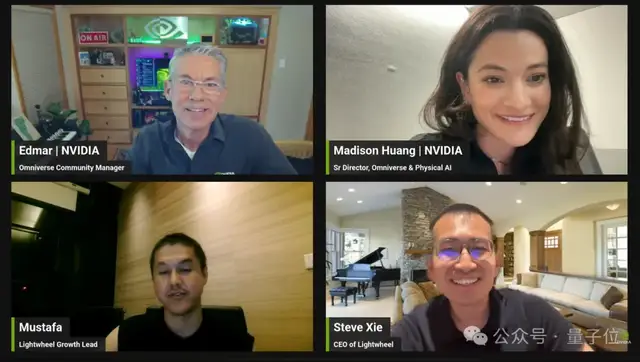
In mid-October, Madison Huang, daughter of Jensen Huang and Senior Director of Omniverse and Physical AI at Nvidia, made her first public appearance on a live interview program with Guanglun Intelligence CEO Xie Chen and Growth Lead Mustafa. They engaged in an in-depth discussion on “how to narrow the gap between robots in virtual and real worlds.”
Earlier this month, during the keynote speech at Nvidia’s GTC DC conference, Jensen Huang showcased collaborative simulation results between Guanglun and Isaac Sim/Newton. The event featured a comparison of robotic arms completing fabric folding tasks across different simulation platforms. Despite using different underlying solvers, the simulated behaviors were highly consistent.
This demonstration not only highlighted Guanglun’s engineering capabilities in cross-platform high-fidelity simulation but also marked that its technical status in the global embodied intelligence training ecosystem is being confirmed by mainstream systems.

Secondly, Guanglun’s client base itself serves as a sample of industry trends.
With the rapid iterative development of embodied intelligence and world models, Guanglun’s customer group almost covers all typical institutions with high-intensity demands for simulation synthetic data.
We reviewed Guanglun’s official presentation materials and compiled its publicly disclosed client list, including but not limited to:
- Large Model Companies: Nvidia, Google, Genesis AI, Alibaba, ByteDance…
- Robot body/platform companies: Figure AI, 1X Technology, Zhiyuan Robotics, Galbot…
- Industry Companies: Toyota, Bosch, BYD, Geely…
It is said that due to various reasons, some partners have not been disclosed publicly, but they are undoubtedly Big Names in the industry.
Several senior figures close to the data industry revealed three pieces of information to us:
First, Guanglun’s clients basically cover all the strongest international embodied large models and world models. Second, more than 80% of the simulation assets and synthetic data for major international embodied teams come from Guanglun. Third, Guanglun has already served all top three global world model companies.
The importance of simulation synthetic data to the industry, as well as Guanglun’s current strength, goes without saying.

As demand expands, Guanglun’s service positioning is no longer simply “supplying simulation synthetic data.” Aligning with market demand rhythms, its services have expanded to cover the entire lifecycle.
In the pre-training phase, it provides synthetic data and human video data to build generalization capabilities; in the post-training phase, it provides high-quality simulation synthetic data and supports model fine-tuning through reinforcement learning; in the testing phase, it offers simulation platform services and evaluation standards, assisting customers with test-time evaluations and launch validations.
This seamless full-process service of data, platforms, and evaluations has become a standard cooperation path used by many leading clients.
This is also the essential difference between Guanglun Intelligence and previous-generation data suppliers: providing not just data, but full-process, full-lifecycle services for data—a data flywheel with an end-to-end closed loop.
This full-process data capability has allowed AI industry ecosystem customers to recognize Guanglun Intelligence’s golden positioning through demand feedback and “voting with their feet.”
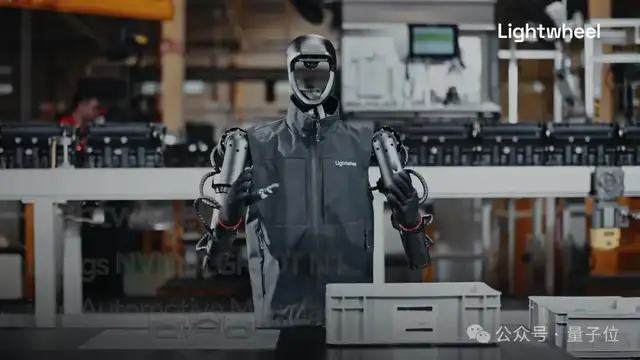
This golden positioning is also reflected more intuitively in tangible cash-generating capabilities. This website has learned that although still in its early startup stage, Guanglun Intelligence’s annual revenue has already broken through 100 million yuan.
This level of income represents not only growth speed but also the reliability of delivery capabilities and business models.
Founder Xie Chen mentioned in a public interview that securing the first client after the company’s establishment in 2023 was not easy.
But once word-of-mouth began to spread, it is said that Guanglun’s customer numbers started expanding continuously and at an accelerated pace. The latest report states:
Revenue exceeds last year by more than ten times, surpassing 100 million yuan.
This change in supply and demand is a direct market feedback on the value of simulation synthetic data.
Additionally, as the saying goes, “Ducks know first when the river warms.” This website also learned that this golden positioning has provided Guanglun Intelligence with a unique perspective: large models, embodied intelligence, world models… every aspect of the AI industry
Before a windfall sector takes off, its potential is often foreshadowed by the business needs of companies like Guanglun Intelligence.
This is also the key reason why the use of funds from Guanglun’s latest funding round has drawn extra attention.
Behind the Hundreds of Millions in Funding Lies the Trajectory of an Entire Industry
An investor told us that the primary purpose of Guanglun Intelligence’s current funding round is to expand supply and strengthen its capacity for scaled delivery.
Synthetic data, which already leads the head market, is driving a pivotal transformation in embodied AI.

From an investment perspective, there is reason to believe that this funding round reveals not only a valuation judgment of Guanglun itself but also shifts in the rhythm of the entire sector.
World models and embodied AI cannot rely on existing internet data. The training bottleneck lies neither in algorithms nor in computing power, but in the ability to continuously supply high-quality structured data. The industry is entering a phase where “data determines performance.”
It is important to note that technological iteration is rapid, and industry progress leaves players with no patience for waiting for data to catch up slowly. There is an urgent need to quickly find service providers capable of synchronously delivering controllable, high-fidelity, and scalable data, ensuring long-term, guaranteed support.
Can it cover pre-training, post-training, and testing phases or the entire workflow? Can it meet multi-model interface adaptation requirements? Can it continuously improve effectiveness within a closed loop of training-generation-retraining?
Competition is intensifying, and every data company will face these questions countless times.
Guanglun’s advantage lies in the fact that these capabilities are already complete. Thus, it has once again taken the lead by extending its goals to a longer-term positioning:
Building the data infrastructure for physical AI.
For Guanglun, this goal is the natural evolution of its business—
The training of embodied AI and world models is long-term and dynamic; demands increase as projects progress. It is impossible for every team to build its own simulation systems or video collection pipelines. The industry naturally requires a “shared data foundation.”
Guanglun started early, possesses a complete technology stack, and has a massive customer base. If it does not act now, other players will inevitably step in soon.
Leveraging first-mover advantages for long-term planning is both grounded in reality and in line with the trend.

Furthermore, behind the new developments in Guanglun’s financing lies a shift in industry perspectives on data:
Data is transforming from “procured resources” into “serviceable platforms.” Embodied AI and world models, which cannot directly consume internet data, require massive ingestion of custom-generated structured scenario data.
Whoever can continuously supply high-quality simulation and human behavior data holds the underlying resources for next-generation intelligent systems. The value of data companies is embedded in this transition.
The wave of change in AI 2.0 has entered a period where infrastructure reform centered on data is paramount.