The Largest AI Infrastructure Project in History Has Launched!
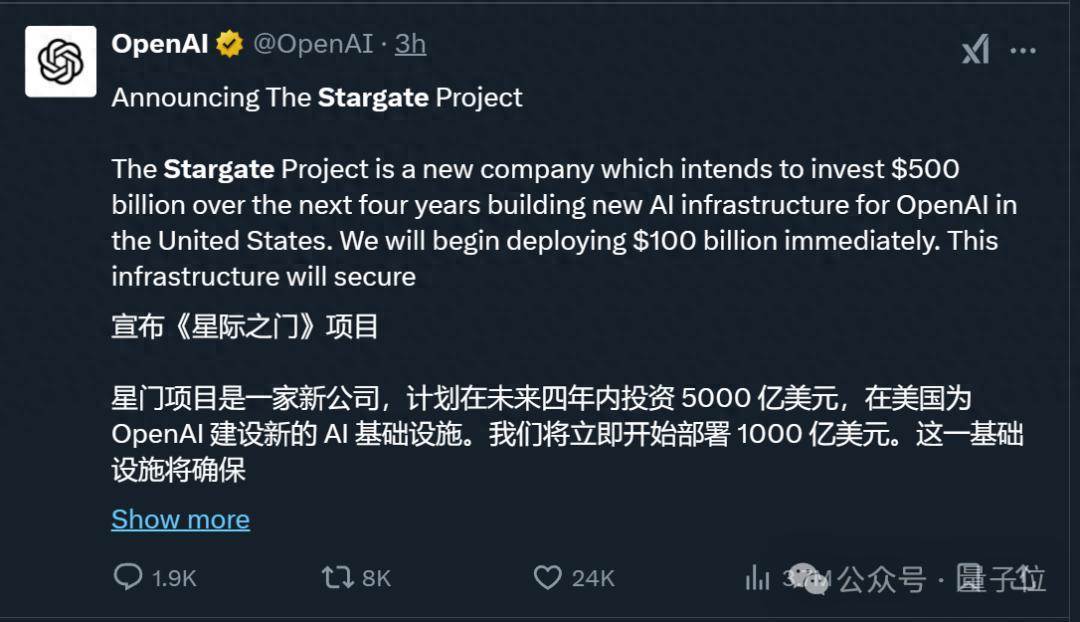
Not long ago, OpenAI officially announced the “Stargate Project” plan—
It will form a joint venture with SoftBank and Oracle to invest a total of $500 billion (approximately 3.64 trillion RMB) over the next four years to build multiple AI data centers in the United States.
The plan is launching immediately, with OpenAI preparing to invest an initial $100 billion right out of the gate.
According to the announcement, this plan is led by OpenAI and SoftBank. OpenAI will handle operations, while SoftBank manages finances. SoftBank CEO Masayoshi Son will serve as chairman of the new joint venture, “The Stargate Project.”
Additionally, Arm, Microsoft, Nvidia, and Oracle will provide support as key technology partners. Construction is set to begin in Texas, before expanding to other states across the U.S.
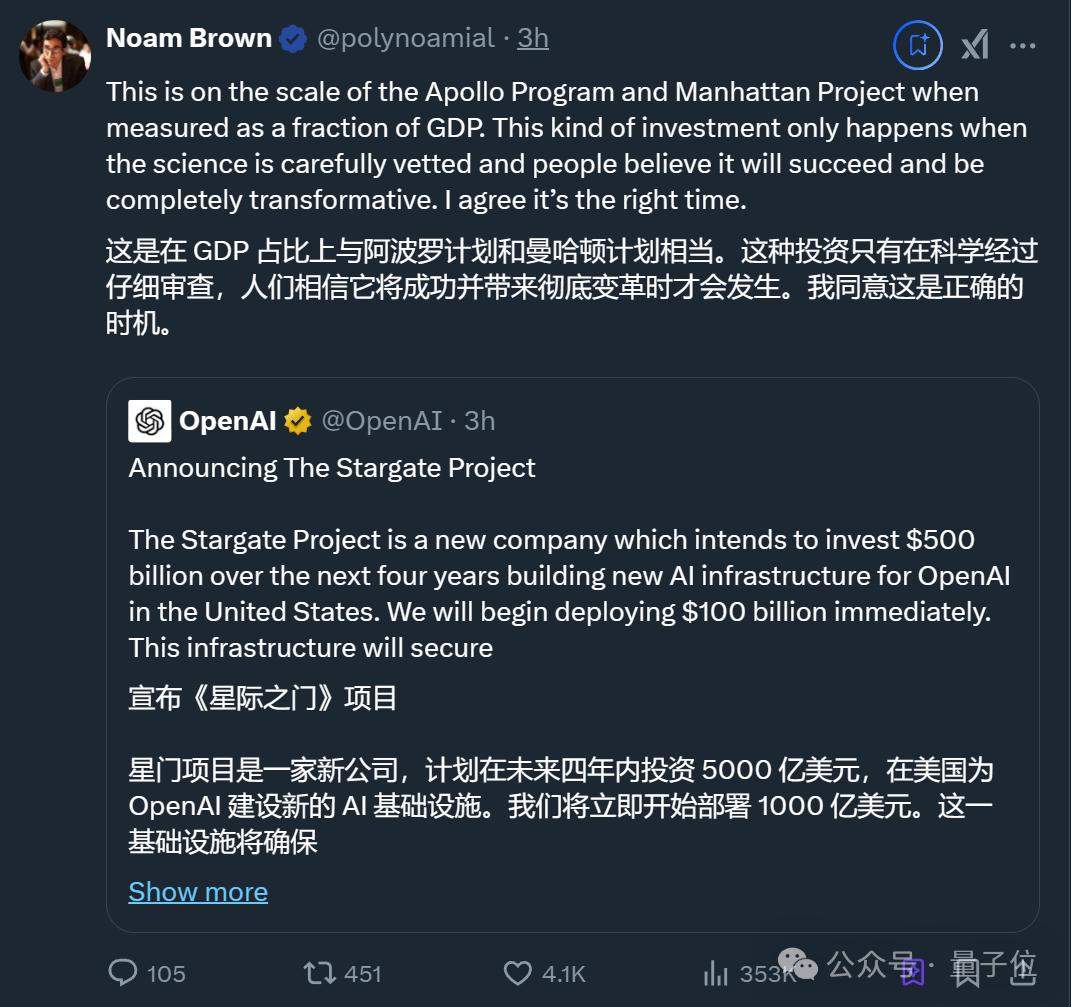
Regarding the scale of this project, according to OpenAI Senior Researcher Noam Brown:
Measured by its share of GDP, this scale is comparable to the Apollo moon landing program and the Manhattan Project.
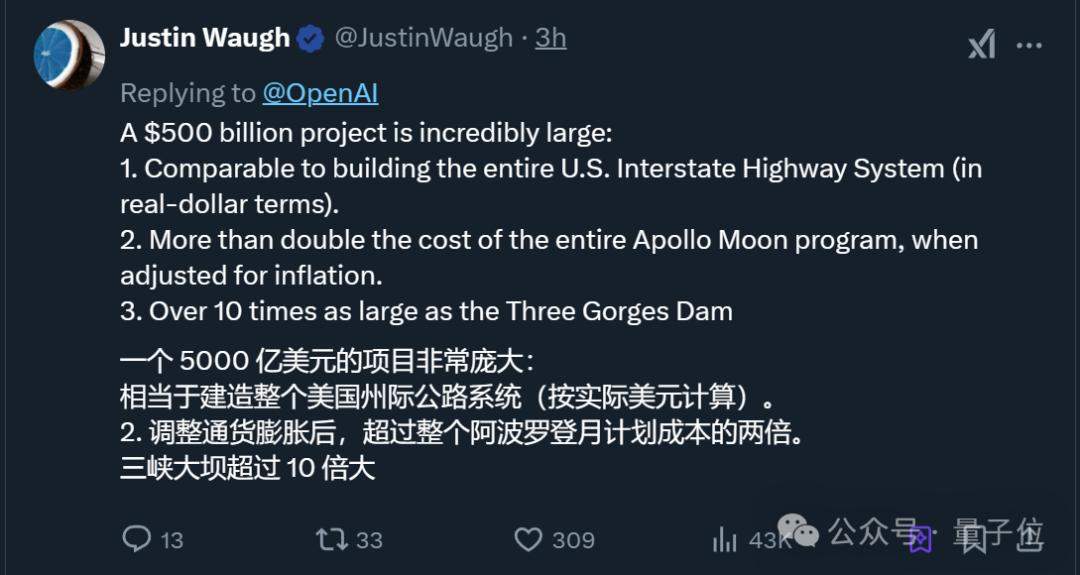
Others have gone so far as to say it is equivalent to building the entire U.S. interstate highway system.
Meanwhile, shortly after the news broke, OpenAI CEO Sam Altman quickly retweeted and posted a new tweet:
build monuments in the desert
Building monuments in the desert
Netizens in the comments section also began to joke around, as seen below:
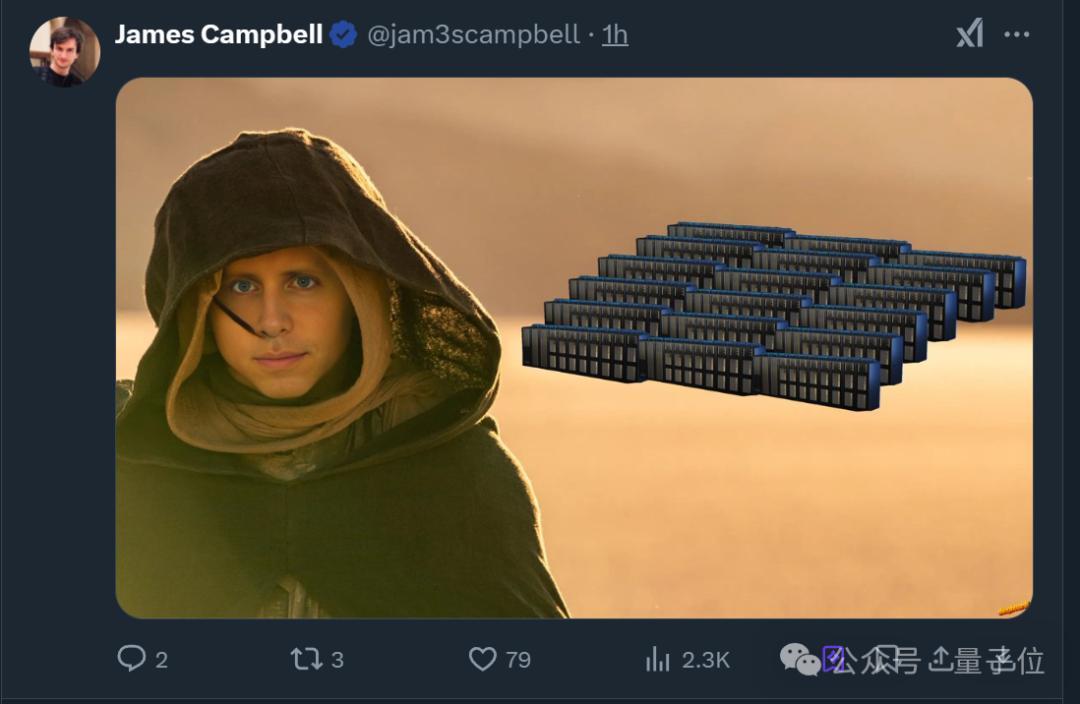
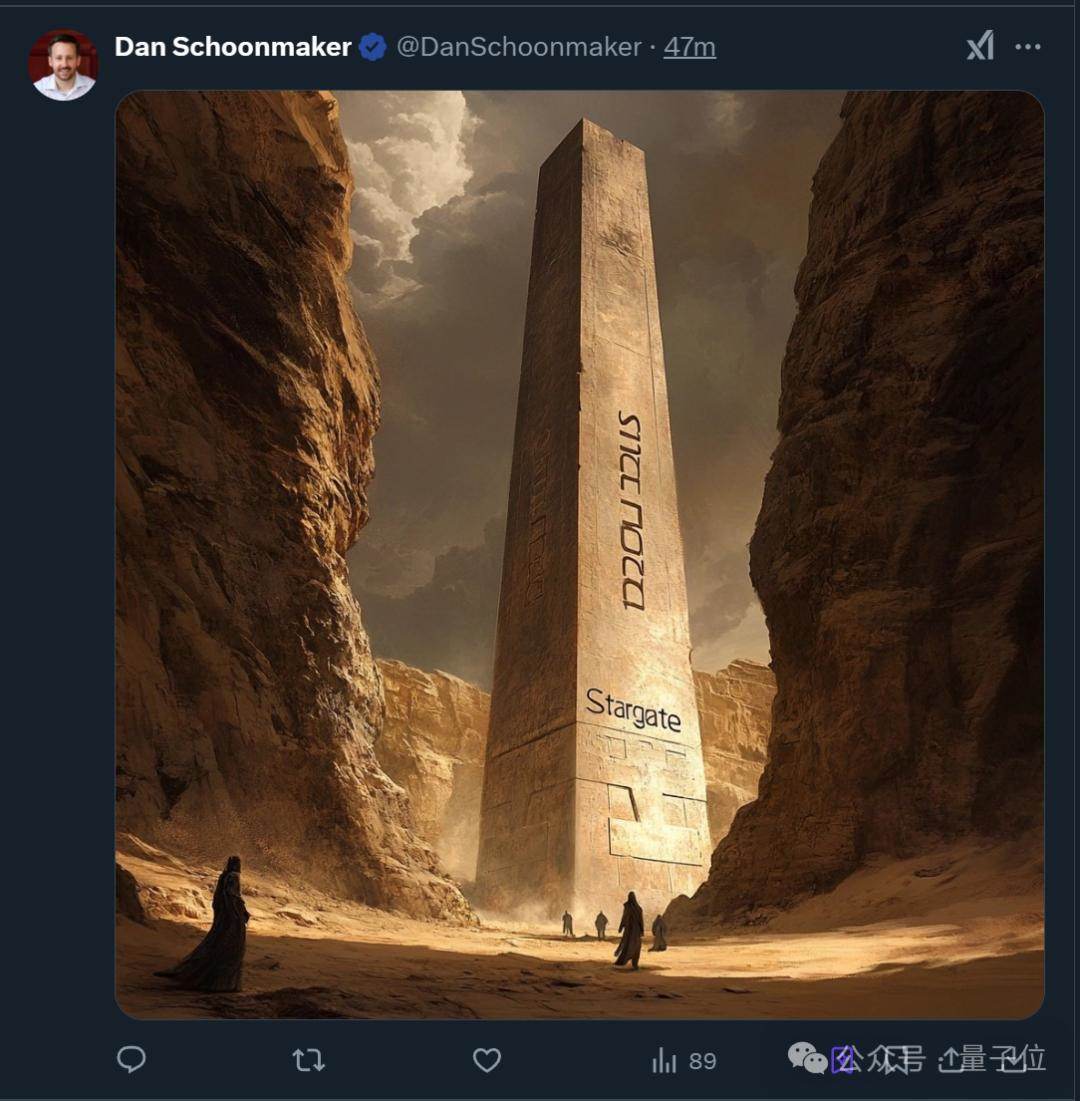
Some even started watching the drama between Altman and Musk:
Altman previously tweeted, “No one is accelerating faster than me,” but later Musk set a record by building the world’s largest supercomputer in just 19 days.

Now, who knows what Musk is cooking up next? (doge emoji)~

At the same time as this news broke, it was reported that Microsoft is no longer OpenAI’s exclusive cloud service provider.
Combined with these developments, OpenAI appears to be seeking greater control over its underlying computing infrastructure.

What exactly is going on? Let’s take a look.
Oracle, Nvidia, and OpenAI to Collaborate Closely
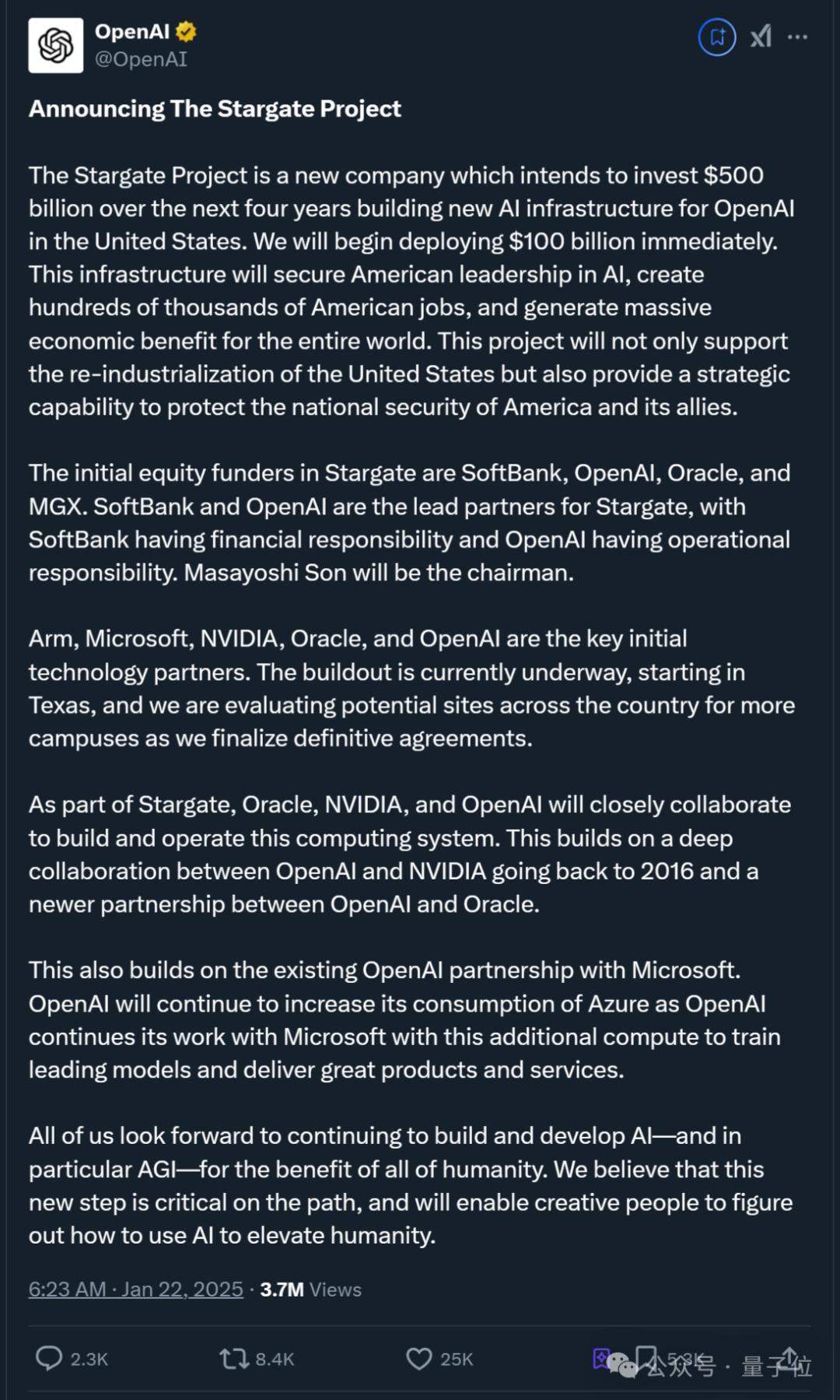
Let’s first review the original announcement from OpenAI, translated and summarized below:
Title: Official Announcement of the “Stargate” Project
The Stargate Project is a new company that plans to invest $500 billion over the next four years to build new AI infrastructure for OpenAI in the United States. We will immediately deploy $100 billion.
This infrastructure will ensure U.S. leadership in AI, create hundreds of thousands of American jobs, and bring significant economic benefits to the world. The project will not only support re-industrialization in the U.S. but also provide a strategic capability to protect national security for the United States and its allies.
The initial equity funders include SoftBank, OpenAI, Oracle, and MGX (the Middle East AI Fund). SoftBank and OpenAI are the lead partners of the project, with SoftBank responsible for finance and OpenAI for operations. Masayoshi Son will serve as chairman.
Arm, Microsoft, Nvidia, Oracle, and OpenAI are key initial technology partners. Construction is currently underway, starting in Texas. As we finalize agreements, we are evaluating potential sites nationwide to establish additional campuses.
As part of the Stargate Project, Oracle, Nvidia, and OpenAI will work closely together to build and operate this computing system. This builds upon the deep cooperation between OpenAI and Nvidia since 2016, as well as the new partnership between OpenAI and Oracle.
This also builds on OpenAI’s existing relationship with Microsoft. As OpenAI continues to collaborate with Microsoft to leverage additional compute power for training leading models and delivering excellent products and services, OpenAI will continue to increase its usage of Azure.
We all look forward to continuing to build and develop AI—particularly Artificial General Intelligence (AGI)—to benefit all of humanity. We believe this new initiative is crucial on this path, enabling creative people to figure out how to use AI to elevate humanity.
Microsoft Is No Longer OpenAI’s Exclusive Cloud Service Provider
In fact, the name of this project easily recalls the collaboration between OpenAI and Microsoft last year.
At that time, The Information reported that they planned to build an AI supercomputer named “Stargate.”
The cost was estimated at up to $100 billion, 100 times the cost of the largest data centers currently in operation. Its power consumption would be enormous, requiring 5,000 megawatts of electricity.
Specifically, the cooperation between the two parties was divided into five phases. Phase four was mentioned at the time, where both were developing a smaller-scale supercomputer costing $10 billion, expected to go online in 2026.
Once breakthroughs are achieved with OpenAI’s large models later on, they will fully push forward with Phase five of “Stargate.” Stargate is scheduled to come online as early as 2028, gradually expanding the scale and scope of the project before 2030.
However, details regarding the subsequent implementation of this cooperation remain unclear.
Furthermore, it remains uncertain whether this new The Stargate Project is related to previous collaborations.

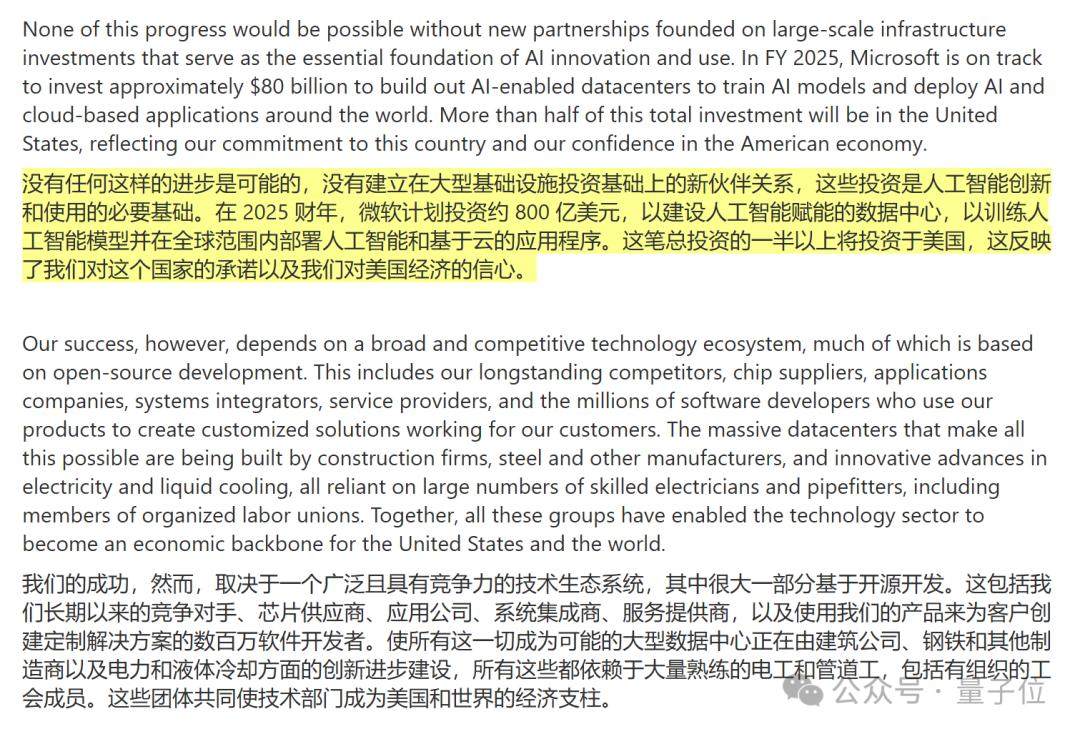
On the other hand, according to Microsoft’s announcement earlier this year, the company plans to invest $80 billion in fiscal year 2025 to build AI data centers.
The blog post also mentioned that the company’s success depends on “new partnerships built upon massive infrastructure investments.”
However, just as OpenAI announced the above plan, Microsoft lost its status as an exclusive cloud service provider.
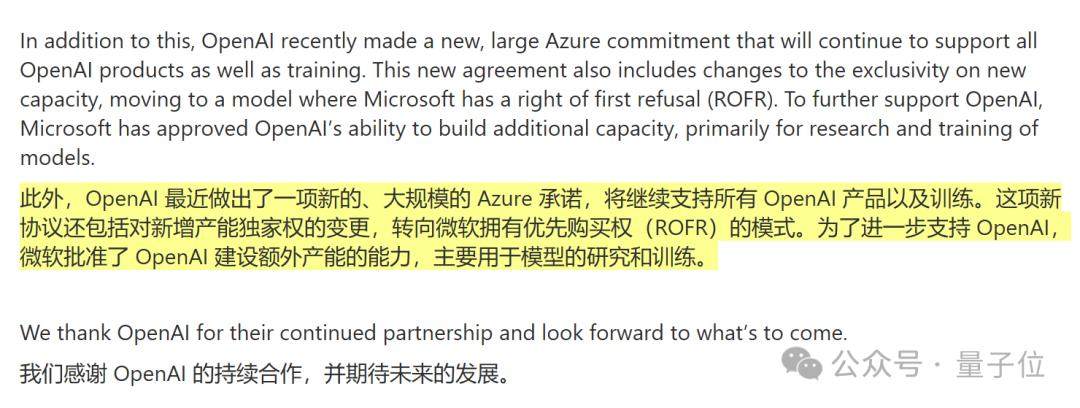
According to another recent announcement from Microsoft, changes have been made to their previous cooperation agreement:
It is no longer the exclusive cloud service provider for OpenAI, but it retains a “Right of First Refusal” (ROFR) on OpenAI’s new cloud service agreements.
In other words, if Microsoft cannot meet the demand, OpenAI can seek support from other cloud service providers.
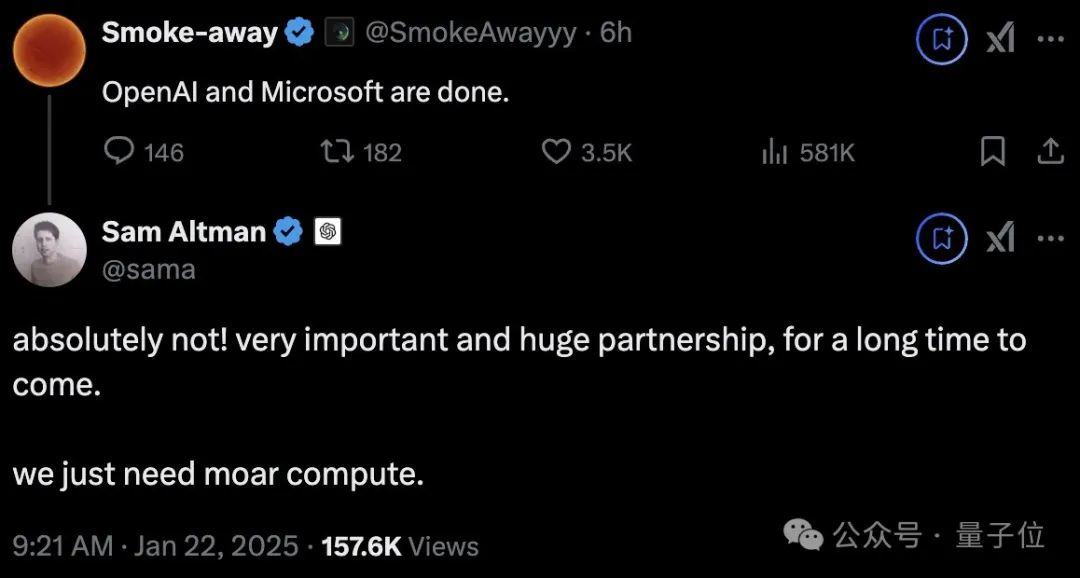
After this news was released, netizens speculated that it might mean a complete breakdown in the relationship between OpenAI and Microsoft.
In response, Altman quickly debunked the rumors:
Absolutely not! … We just need more compute power.
Under this reply, the top-voted comment offered a sharp critique (with a doge emoji):