“Half a screen of ads? Who can stand that?”

As expected, the comments section was flooded with criticism after ChatGPT announced the launch of its advertising feature.
Some users complained that the ads were too large and uncomfortable to look at.

Others questioned why a non-profit organization would pursue commercialization, asking if it had lost its original mission.
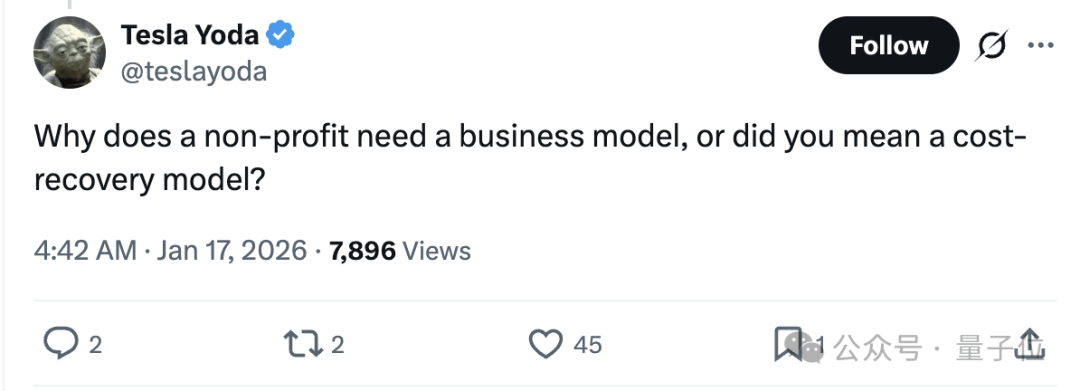
Some said they would simply stop using ChatGPT and switch to Claude or Grok instead.

Others sarcastically renamed GPT to “AdGPT.”

Netizens unleashed a barrage of criticism, and Sam Altman’s past statement that “ads are ChatGPT’s last lifeline” came back to haunt him like a boomerang.
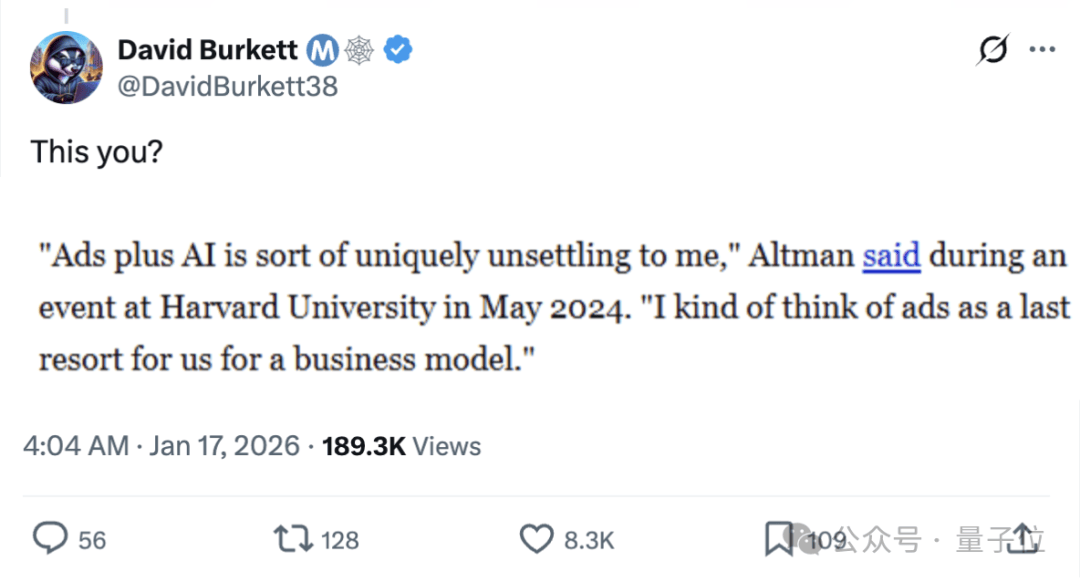
The question is: Why proceed with ads when you know it will invite backlash?
The answer is simple—
OpenAI is running out of money, and Altman has no other options.
OpenAI Is Running Out of Money
OpenAI’s financial troubles are not baseless rumors. A report by The New York Times explicitly stated:
OpenAI faces a cash crunch within 18 months and is likely to be acquired by well-funded giants like Microsoft or Amazon.
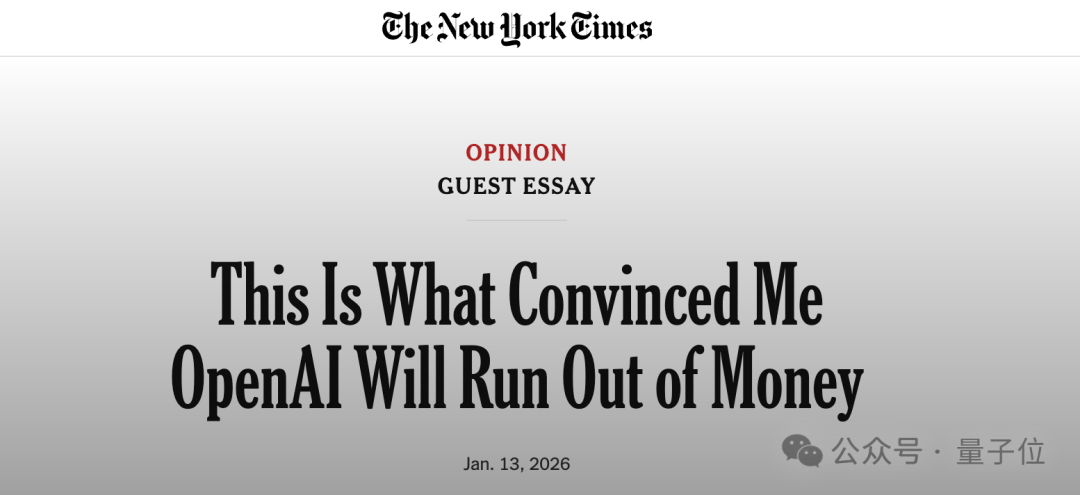
At first glance, it seems hard to believe that OpenAI could run out of money in just a year and a half.
After all, Altman is a “superhero” when it comes to fundraising.
For instance, last March, Altman set a record by raising $40 billion, more than any other company has raised in private funding rounds.
Throughout his nearly 10-year tenure as CEO of OpenAI, fundraising has been continuous.
However, the problem is that while OpenAI raises large sums, it also burns through them quickly.
Data shows that OpenAI’s annual burn rate is expected to exceed $8 billion for all of 2025, reaching $40 billion by 2028.
Strangely enough, OpenAI’s $1.4 trillion data center construction plan still awaits continuous capital injection.
In contrast, OpenAI’s annual revenue last year was only $20 billion. The disparity between income and expenditure at such different magnitudes poses a significant financial challenge.
More critically, industry consensus suggests that even under the most optimistic scenarios, the entire AI sector faces a funding gap of at least $800 billion, further tightening OpenAI’s financial situation.
Unlike Google, Microsoft, and Meta, which have mature traditional businesses to subsidize new ventures, OpenAI has almost no “safety cushion.”
In this context, renting out the screens of its 800 million monthly active users to advertisers seems like a move Altman had no choice but to make.
Although this move will undoubtedly attract heavy criticism, it may indeed be what Altman previously described as their “last lifeline.”
In fact, Altman had already planned to launch ads last December.
However, the aggressive entry of Google’s Gemini 3 triggered a “code red” at OpenAI.
Consequently, the plan was delayed, and the focus shifted temporarily to competing with Google and Anthropic.
Now that things have eased slightly, the ad plan has been immediately reinstated.
According to someone close to OpenAI, the company expects to generate revenue in the “low billions” from ads in 2026, scaling this income source year by year thereafter.
However, whether this plan will succeed remains to be seen.
It depends on whether users will vote with their feet due to the ads and whether other companies will follow OpenAI’s lead in adopting an ad model.

Additionally, insiders revealed that OpenAI is holding preliminary discussions with investors for a new funding round, which could reach $80 billion.
OpenAI’s Commercial Closed Loop
For this startup valued at nearly $750 billion with over 3,000 employees, the ad feature was not accidental; it is part of OpenAI’s broader commercial strategy.
Since last Friday, when OpenAI announced it would test ads in the free version of ChatGPT, the initial testing group has been logged-in adult users in the United States.
Ads will appear at the bottom of ChatGPT responses and are clearly labeled as “sponsored content.”
This move marks a significant step for OpenAI in expanding its business model from relying solely on subscription revenue to incorporating advertising income.
OpenAI emphasized that ad content will not affect ChatGPT’s answers, reassuring users that they can trust the objectivity of its responses.
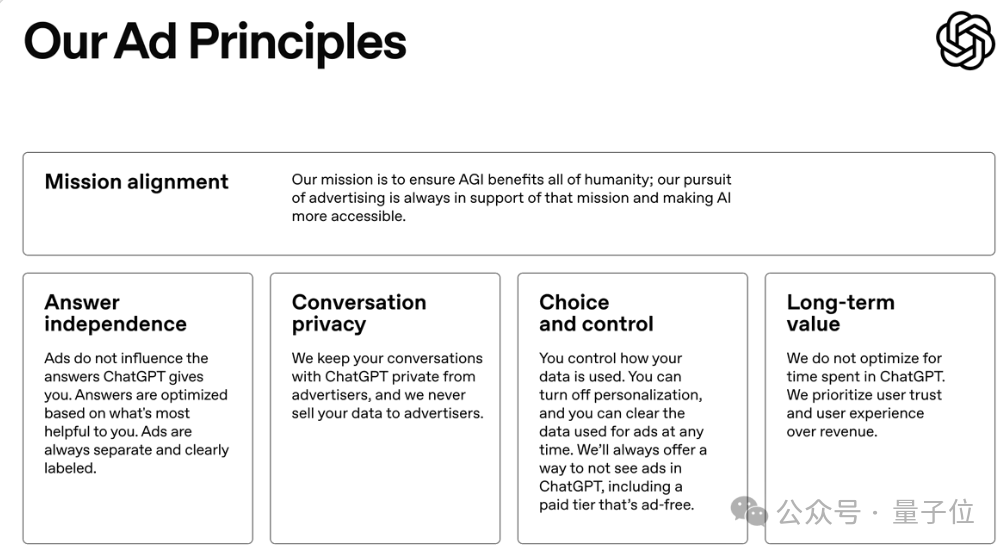
OpenAI will not sell user data or conversation content to advertisers, and users can turn off ad personalization based on chat history.
Additionally, OpenAI launched a new subscription tier called Go for $8 per month, offering upgraded features such as longer memory capacity and increased image generation capabilities.

However, Go subscribers will still see ads, while Plus ($20/month) and Pro ($200/month) subscription tiers, as well as OpenAI’s enterprise clients, will remain ad-free.
Beyond advertising, OpenAI Chief Financial Officer (CFO) Sarah Friar revealed the company’s subsequent commercial plans and the rationale behind its infrastructure investments in a newly released report titled:
“A Business Model That Scales with Intelligence Value.”
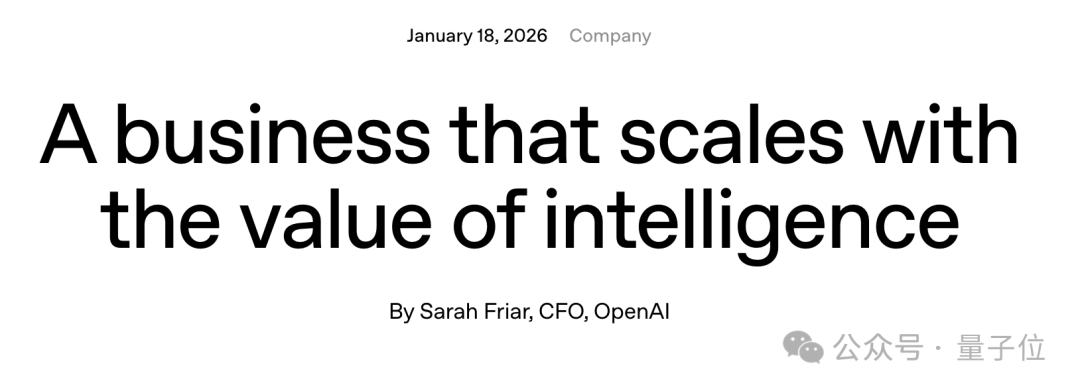
In it, Sarah Friar stated that OpenAI’s core principle is:
The business model should scale in line with the value created by intelligence.
For example, when users require greater capabilities and higher reliability, OpenAI introduced consumer subscription services.
As AI gradually integrates into teams and workflows, the company launched workplace subscriptions and introduced usage-based billing models to align costs with actual work completed.
Simultaneously, OpenAI has built a platform business, allowing developers and enterprises to embed intelligence into their systems via APIs, where expenses are directly tied to delivered outcomes.
The ad feature launched last week is intended to further support users in making decisions within commercial and transactional contexts.
In the future, besides advertising revenue, OpenAI will continue to drive income growth through subscription tiers and usage-based APIs linked to production workloads.
As AI agents penetrate fields such as scientific research, drug discovery, energy systems, and financial modeling in the coming years, new distribution models—including licensing, IP-based partnerships, and outcome-based pricing—will emerge.
Achieving this goal requires massive investment in infrastructure.
Sarah Friar pointed out in her report that OpenAI’s Weekly Active Users (WAU) and Daily Active Users (DAU) have consistently hit record highs.
This growth is driven by a flywheel effect fueled by compute power, cutting-edge research, product development, and monetization:
Investment in compute drives leaps in research and model capabilities; powerful models lead to better products and wider adoption, which in turn drive revenue growth; revenue then supports the next round of compute investment and innovation. This cycle reinforces itself continuously.
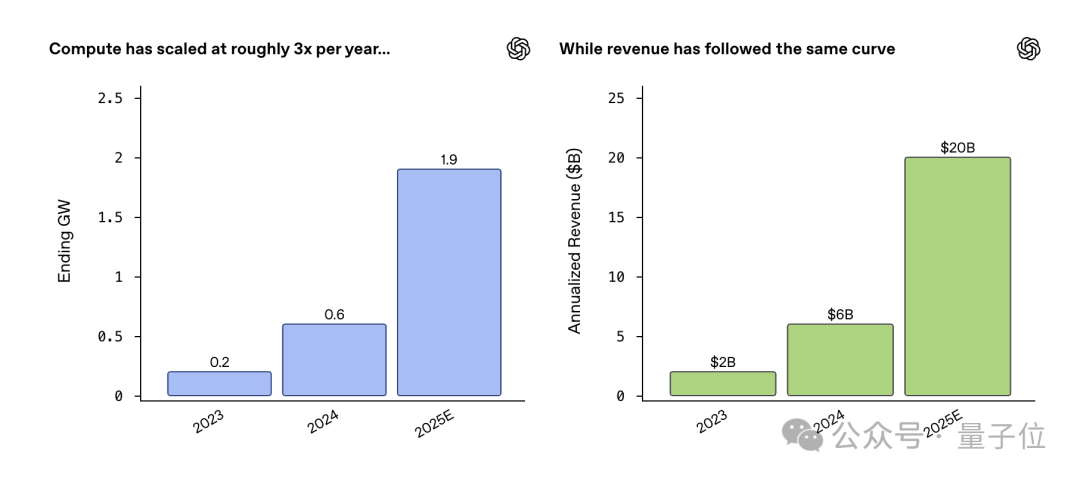
According to data in the report, OpenAI’s compute capacity grew 9.5 times between 2023 and 2025, with revenue following a similar trajectory, increasing threefold year-over-year and tenfold over the three-year period.
Specific figures are as follows:
- 2023: Compute 0.2 GW, ARR (Annual Recurring Revenue) $2 billion
- 2024: Compute 0.6 GW, ARR $6 billion
- 2025: Compute 1.9 GW, ARR exceeding $20 billion
All of this indicates that compute power and revenue growth are closely linked.
Increased compute investment leads to increased revenue.
In the future, as compute capacity continues to rise, the pace of revenue growth will accelerate further.
From launching ad features to expanding its business model, every step OpenAI takes now appears somewhat constrained compared to Google’s calm confidence.
The reality of “running out of money” forces it to make this choice, and advertising may only be the first step in addressing immediate pressures.
References
- ec1656cd e07b 48ed 92a8 26c7fe517899 — www.ft.com/content/ec1656cd-e07b-48ed-92a8-26c7fe517899
- openai is the 2025 yahoo finance company of the year 120054312 — finance.yahoo.com/news/openai-is-the-2025-yahoo-finance-company-of-the-year-120054312.html
- a business that scales with the value of intelligence — openai.com/index/a-business-that-scales-with-the-value-of-intelligence/
- OpenAI could reportedly run out of cash by mid-2027 — analyst paints grim picture after examining the company’s finances — The circular economy might spiral into Sam Altman’s garrote.