OpenAI’s Latest Podcast Release:
Chief Financial Officer Sarah Friar and renowned investor Vinod Khosla gathered to discuss AI trends for 2026.
The discussion was packed with insights, highlighting that next year will mark the official debut of multi-agent systems. Key topics included how the AI industry is trading compute power for revenue, breaking through the upper limits of large model capabilities, and the transformative impact on healthcare and embodied intelligence industries.

To be honest, releasing such an interview at this moment carries obvious implications:
It serves not only as a response to recent public opinion surrounding OpenAI but also as reassurance for investors that “AI is not a bubble; OpenAI is worth investing in.”
The subtext is clear: paving the way for OpenAI’s upcoming IPO. This will be the top priority for OpenAI in 2026.

Beyond OpenAI’s own narrative, the macro-perspective on the industry is quite interesting. Some core viewpoints include:
2026 will be the true year of agents.
There is a clear positive correlation between compute power and revenue.
The true indicator of an AI bubble is not stock price, but API call volume.
In ten years, global economies will enter an era of mass deflation due to AI.
Here are more details.
2026 Keyword: Multi-Agent Systems
OpenAI first established a consensus: 2026 belongs to multi-agent collaboration.
If 2025 saw AI development revolving around Agents and Vibe Coding, then 2026 will be the critical juncture where multi-agent systems mature and generate tangible impact.
At the enterprise level, multi-agent systems will handle a series of complete complex tasks, such as running Enterprise Resource Planning (ERP) systems, daily reconciliations, and real-time tracking of contract execution.
On the consumer side, multi-agent systems will be more pragmatic, comprehensively considering multiple dimensions like dietary preferences, flight schedules, and personal calendars when planning itineraries.

Additionally, many fields previously constrained by technical bottlenecks will gradually achieve breakthroughs in the future.
Taking large models as an example, their standard performance in memory capabilities, continuous learning, and hallucination suppression will see significant optimization.
Meanwhile, frontier directions such as embodied intelligence models and world models will also make substantial progress.
2026 will mark the beginning of a narrowing gap between technical capability and user experience.
Whether for enterprise or individual users, AI’s potential will be fully unleashed, transforming it from simple chatbots into true task executors.
Compute Power Equals ARR
As for the primary factor limiting demand growth, it remains compute power.
OpenAI views compute power as the infrastructure of the AI era; whoever masters compute power gains the first-mover advantage.
Furthermore, while spending heavily on compute may seem unprofitable at first glance, it is actually highly lucrative: the more you spend, the more you earn, with a strong positive correlation between the two.
Compute investment drives research and leaps in model capability. Powerful models lead to better products and wider adoption, which in turn drive revenue growth. Revenue then supports the next round of compute investment and innovation. This cycle reinforces itself continuously.
This point is corroborated by OpenAI’s latest published ARR (Annual Recurring Revenue) data.
Over the past three years, OpenAI’s compute capacity has grown annually from an initial 200 megawatts to 1.9 gigawatts, with revenue correspondingly increasing from $2 billion to over $20 billion.
They follow the same growth curve, showing a trend of continuous accelerated growth.
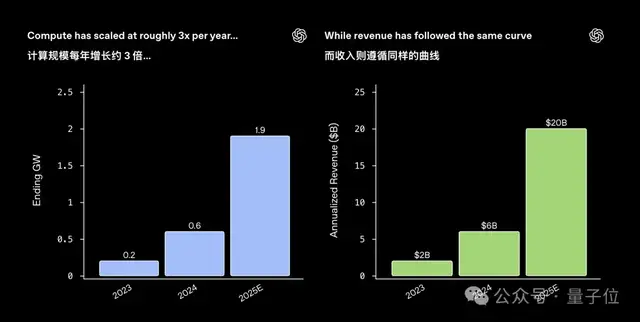
Clearly, OpenAI’s large-scale bets on compute power have been effective. However, it remains to be seen whether OpenAI has enough capital to sustain this level of spending. (doge)
In fact, not just OpenAI, but major global AI giants are all emphasizing the importance of compute power in unison.
Elon Musk recently mentioned in an interview:
The currency of the future is essentially watts.
Trading compute for money has become an open secret within the AI industry.
With more compute power, OpenAI can launch more products, models, and multimodal applications, leading to OpenAI’s next step—multi-dimensional transformation.
At the infrastructure level, OpenAI will achieve multi-cloud and multi-chip architectures to provide diverse support for underlying technology. For consumers, OpenAI will evolve from its initial single ChatGPT product into a multi-product structure (such as Sora, health modes, etc.).

In terms of business models, a multi-tier subscription system has already been formed. For example, offering Software-as-a-Service (SaaS) pricing for enterprises and introducing credit-based billing specifically for high-value scenarios.
The recently added advertising business is also part of this strategy. By renting out the screens of its 800 million monthly active users to advertisers, OpenAI expects to generate billions of dollars in revenue this year.
However, there is no need to worry that ads will affect ChatGPT’s output results. OpenAI has explicitly stated that models will always provide optimal solutions for users rather than paid promotional answers.

They will also actively innovate ad formats to integrate naturally with the platform ecosystem, avoiding traditional banner ad models, while always retaining an ad-free service option to give users full choice.
In the future, OpenAI is considering new licensing models. For instance, in drug development, it could license technology to partners; once they achieve breakthrough results, OpenAI would collect a percentage of pharmaceutical sales as licensing revenue, thereby aligning interests.
In short, OpenAI stated that it will combine the most suitable value modules from these three levels (infrastructure, products, and business models) to fulfill its ultimate mission of achieving AGI.
Rejecting Wall Street’s Bubble Theory: API Call Volume is the Hard Metric
OpenAI also debunked the notion of an AI bubble this time.
First, a fact must be clarified: a bubble does not equal stock price volatility. Stock price fluctuations are only related to market sentiment; the indicator for measuring an AI bubble should be API call volume.
Taking the internet era as an example, people often spoke of the “internet bubble” back then. However, the true standard for judging whether it was a bubble was network traffic, not daily stock prices.
From this perspective, API call volumes currently show no signs of decline. In other words, AI is far from being a bubble; rather, Wall Street is manufacturing anxiety.

Conversely, what AI brings is tangible productivity enhancement.
It is eliminating tedious repetitive work. Previously, OpenAI’s finance team needed to hire many employees to review contracts. Now, using internal AI tools, all contracts can be automatically extracted and stored in the database overnight, greatly saving time and labor costs.
McKinsey’s research shows that among the top 25% of companies, productivity across various financial metrics has increased by 27% to 33% due to AI.
This means employees at this stage can shift toward more decision-making work, generating higher economic value.
AI Technology Predictions
In addition, two key directions worth attention in the future of AI are healthcare and robotics.
Healthcare can be viewed as a field where AI will bring revolutionary changes. It allows doctors to access the latest research findings promptly, understand drug interactions, and assess the compatibility of patient conditions with treatment plans.
It also empowers ordinary users with more autonomy, allowing them to understand their symptoms in advance and engage in more targeted communication with doctors or seek second opinions.

Data shows that currently, 230 million people consult ChatGPT about health issues every week. Additionally, 66% of U.S. doctors stated they use ChatGPT in their daily work, and this proportion continues to rise.
This indicates that AI’s impact on healthcare has already begun, bringing regulatory issues that need to keep pace.
On the other hand, OpenAI predicts that in 15 years, the robotics market size will surpass today’s automotive industry, becoming one of the largest industries globally.
Although there have been no breakthrough developments yet and many complex technical challenges remain, it is worth looking forward to robots not only handling basic manufacturing tasks but also making breakthroughs in addressing human loneliness and providing family companionship.
Especially against the backdrop of an aging population, humanoid robots can be endowed with unique significance simply by providing emotional value.
This will be the first step for the robotics industry’s value to surpass that of the automotive sector.
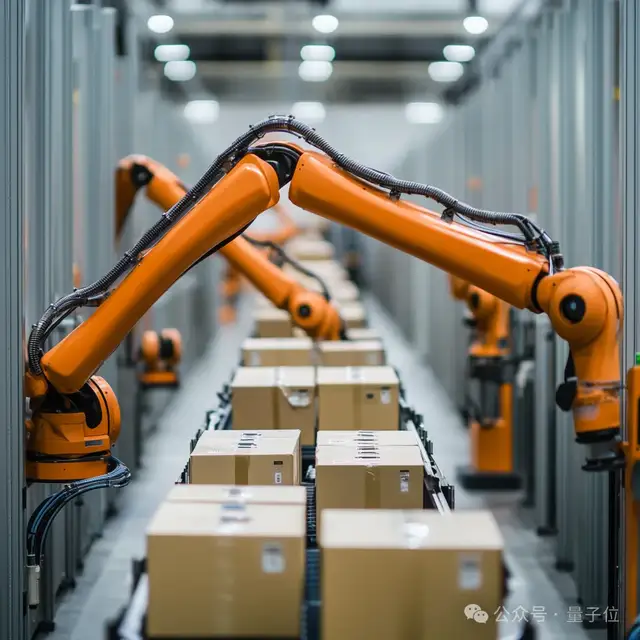
Simultaneously, with the enhancement of smart living and working environments, in the next decade, the global economy will enter an era of mass deflation.
Specifically, as AI deeply integrates into the world, labor costs will drop sharply, becoming nearly free. The costs of more goods, such as specialized knowledge, will also decrease accordingly.
In Musk’s view, under these circumstances, the growth rate of output for goods and services will exceed the growth rate of money supply, ultimately leading to deflation. At that time, it might be possible to simply distribute money to everyone, only to find that there is too much to spend.
As for startups, OpenAI suggests that now is not a good time to compete with general models. Instead, companies should focus on specific domain data assets, such as enterprise data behind firewalls or complex business workflow management.
In short, in the AI era, traditional experience in understanding certain fields becomes less important. The core lies in possessing the ability to proactively drive events forward, making one’s own value scarce, and thereby building a sufficiently thick technological moat.
References
- State of the AI industry — the OpenAI Podcast Ep. 12 — OpenAI CFO Sarah Friar and Khosla Ventures founder Vinod Khosla argue the greatest challenges in AI right now are keeping up with demand and making sure more…
- a business that scales with the value of intelligence — openai.com/index/a-business-that-scales-with-the-value-of-intelligence/