There really is no such thing as a free lunch!
To get “Mickey Mouse” into Sora, OpenAI has officially announced a partnership with Disney.
One of the terms of the agreement is that OpenAI must sell $1 billion worth of its equity to Disney, and Disney also retains the right to increase its stake in the future.
The news was immediately picked up by Bloomberg, which led the coverage with an article title that was quite blunt:
Just realized there’s no free lunch at Disney.
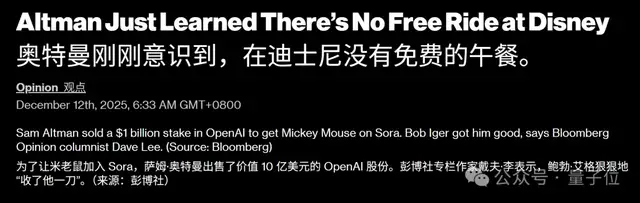
Given this significant financial concession, CEO Sam Altman and President Greg Brockman’s celebratory tweets now seem a bit forced (just kidding).
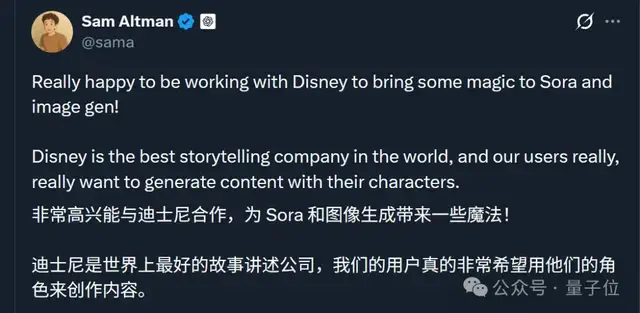
However, as a trade-off, Sora, the video generation tool under OpenAI, can now “legitimately” generate over 200 popular IP characters.
Mickey Mouse, Snow White, Buzz Lightyear, Iron Man, and more are all included.
ChatGPT Images will also possess equivalent capabilities.
It has to be said that Disney’s reputation as the “strongest legal department on Earth” is well-deserved; even OpenAI now has to effectively “cut flesh” to ensure peace.
OpenAI and Disney Strike a Three-Year Deal
Jokes aside, let’s look at the formal agreement reached between the two parties.
According to an announcement from OpenAI, Disney will become Sora’s first major content licensing partner, with a three-year cooperation period. The license for the first year is exclusive.
Under the agreement, Sora will receive licenses for more than 200 characters owned by Disney, including but not limited to:
- Disney Classic Characters: Mickey Mouse, Minnie Mouse, Cinderella, Belle, Baymax, Simba, etc.;
- Pixar Characters: Toy Story, Inside Out, Moana, Monsters, Inc., etc.;
- Marvel Characters: Iron Man, Thor, Captain America, Black Panther, Deadpool, Thanos, etc.;
- Star Wars Characters: Darth Vader, Han Solo, the Skywalker family, The Mandalorian, Yoda, Stormtroopers, etc.
The scope of the license extends beyond the characters themselves to include costumes, props, vehicles, and iconic scenes.
In addition to Sora, ChatGPT Images will also have these capabilities, allowing users to generate images related to these IPs in seconds with just a short text prompt.
However, it is important to note that the agreement explicitly states that the licensed scope does not include the likeness or voice of any real person.
Additionally, some fan-created Sora short videos may be broadcast on Disney’s online streaming platform, Disney+.
Note this: This feature is expected to officially launch in early 2026, at which point users will be able to create content using these classic characters.
Beyond IP licensing, Disney has also deeply tied its interests with OpenAI.
On one hand, it is actively investing money into OpenAI.
As part of the agreement, Disney will make a $1 billion equity investment in OpenAI and receive warrants to purchase additional equity.
On the other hand, it is advocating for the active use of AI within its company and has become an important enterprise client of OpenAI.
According to the agreement, Disney will utilize OpenAI’s API to build new products, tools, and experiences, with applications covering the streaming platform Disney+.
It will also deploy ChatGPT for Disney employees to use in internal workflows.
Disney CEO Bob Iger stated:
The rapid advancement of artificial intelligence marks a pivotal moment for our industry. Through our partnership with OpenAI, we will thoughtfully and responsibly expand the reach of storytelling through generative AI. This will put imagination and creativity directly into the hands of fans, allowing them to connect with their favorite characters and stories in ways never before possible.
Is There Hope for the Sora App?
With OpenAI hitching a ride on Disney’s fast ship, the Sora app might just be salvageable.
How so?
Earlier this month, a16z partner Olivia Moore shared data showing that the retention rate of the Sora app is concerning.
This application, which grew faster than ChatGPT (reaching over one million downloads in five days), saw its user retention drop from 10% (Day 1) to 2% (Day 7), 1% (Day 30), and 0% (Day 60). It should be noted, however, that the Sora app has only been online for about 60 days…
Still, this indicates that even if new user acquisition continues, users are not staying with the app—they get bored quickly.
Many netizens have reported that the content on the Sora app suffers from significant homogenization, leading to boredom (especially given Sam Altman’s frequent appearances).
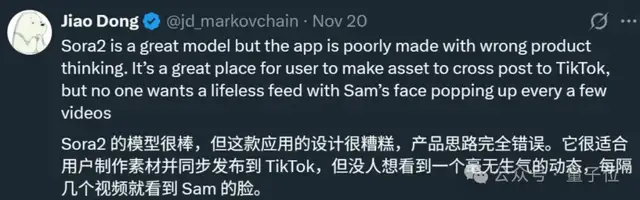
Now, with official licensing from Disney, the ceiling for what can be done with the Sora app has been completely opened up.
Previously, there were too few playable assets, they were repetitive, and lacked emotional value. Even as the Sora model evolved, these capabilities could not be fully utilized due to copyright restrictions.
Now, the situation is entirely different. What Disney brings is not just a simple library of characters, but a method of creation based on shared emotional connections among all users.
Because these popular IPs carry the collective memories and emotional expressions of countless people, the content created using them naturally attracts attention and has greater appeal.
This may also be OpenAI’s broader consideration beyond copyright compliance.
As mentioned before, OpenAI currently resembles more of a research company, with relatively weak product operations capabilities.
However, with the boost from Disney’s popular IPs, it is evident that operational difficulties will decrease. After all, these assets come with inherent popularity and value; the platform only needs to provide basic guidance and rule design to leverage the gravitational pull of the IPs themselves, naturally forming a highly active creative ecosystem and dissemination network.
Therefore, the Sora app, which has been struggling with retention rates, might just be saved by Disney in this way.
OpenAI Finally Gets Serious After Too Many Pitfalls
Finally, let’s return to OpenAI.
Looking back at its past copyright controversies, it is not difficult to understand why it chose to “trade equity for copyrights” this time.
As image, voice, and video models continued to develop, and as people used OpenAI models for more content creation, instances of infringement involving popular IPs began to increase.
The most prominent controversy was the Scarlett Johansson incident.
Last year, OpenAI released a new voice called “Sky” in ChatGPT, which was later found to be extremely similar in style to Scarlett Johansson’s own voice.
Amidst widespread discussion, Johansson’s public statement placed OpenAI squarely in the crosshairs of copyright infringement allegations.
She stated that she had previously declined an offer from OpenAI for collaboration, but the model’s voice ultimately “sounded like her,” leading her to believe that her likeness and vocal characteristics were used without permission.
In response, OpenAI quickly announced it would suspend the use of the “Sky” voice and replace it with a voice named “Juniper.” In its statement, OpenAI explained that the “Sky” voice was not an intentional imitation of Johansson but was generated based on natural recordings from another professional actress, emphasizing that all AI voices were derived from materials provided by legitimate voice actors.
While this may be true, the rift in public trust toward OpenAI had already formed.
Regarding Disney, it is worth noting that even before OpenAI launched its Sora short video app earlier this October, insiders revealed that Disney had already sent a letter to OpenAI.
Disney clearly stated that it had never authorized the company or Sora to copy, distribute, publicly display, or perform any images or videos containing Disney’s copyrighted works and characters, while emphasizing that Disney “has no obligation to maintain its rights under copyright law through an ‘opt-out’ mechanism,” directly pointing out the unreasonableness of Sora’s mechanism in terms of copyright protection.
(To avoid copyright risks, OpenAI typically assumes that content from copyright holders can be used for model training unless they actively submit a request to remove their content from the training data.)
It is reasonable to speculate that OpenAI and Disney have been negotiating behind the scenes over the past two months, and this recent agreement marks the initial cooperation.

After OpenAI, Disney’s next target is also clear: Google.
According to the latest report from The Verge, Disney has sent a cease-and-desist letter to Google regarding copyright infringement.
The reasons for accusing Google include using AI models and related services to infringe on Disney’s copyrights on a large scale by generating and distributing images and videos involving classic Disney IPs for commercial use.
Hmm, familiar style, familiar “routine.”
With OpenAI setting the precedent, it wouldn’t be unreasonable to dream of a cooperation between Google and Disney (wink).