The Agent track is bustling with activity. What makes the experience of Nano AI Search, heavily promoted by Zhou Hongyi, any different?
First, it remains incredibly “crowded,” and a slight misstep can easily crash the servers.

However, after conducting further hands-on tests, we found that Nano AI Search, in terms of both its access method and product features, is distinctly “Old Zhou” (Zhou Hongyi’s style)…
Here are the conclusions:
First, it has significantly lowered the barrier to entry for using MCP. As the first truly consumer-facing (toC) MCP platform, ordinary users can now genuinely experience advanced agents based on MCP. Previously, MCP was primarily aimed at professionals and gained popularity among developers. Now, Nano AI’s 400 million users can call upon a vast array of MCP tools to complete complex real-world tasks.
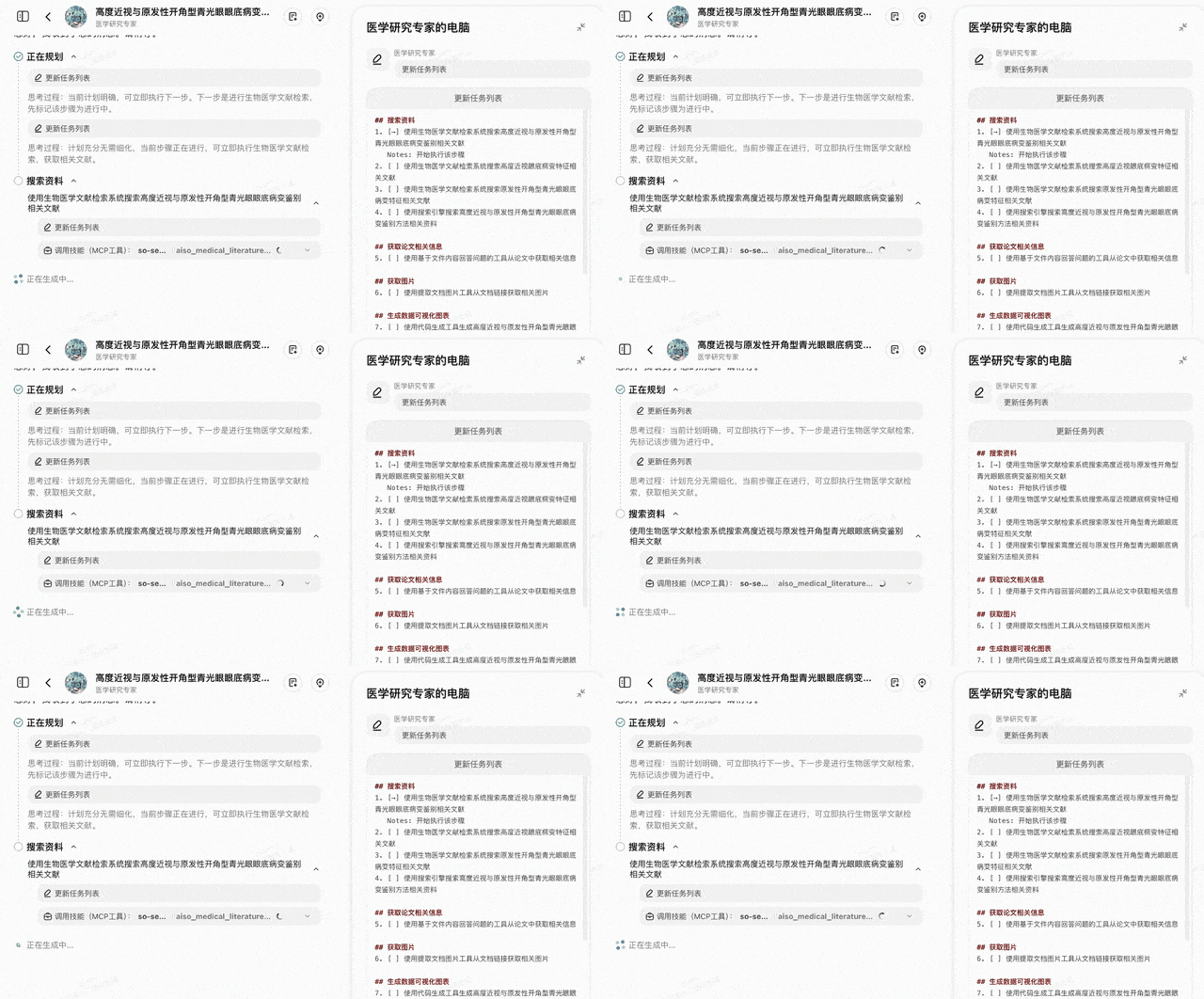
Second, it represents a truly open MCP ecosystem. Nano AI currently boasts over 100 self-developed and curated MCP tools, with more third-party MCP tools in the process of joining.
Furthermore, one can see the continuation of 360’s technical advantages and product style: opting for local deployment and MCP tool integration rather than the typical cloud-hosted model. This makes it easier to bypass login walls and ad barriers during deep model retrieval and social media operations, ensuring convenience without compromising security concerns.

Let’s delve into the specific details.
Hands-on Test of Nano AI’s Universal Toolbox
Using Nano AI’s Universal Toolbox is straightforward: simply download the app, register, and log in. No additional configuration is required; the entry point is located on the left-hand side under the “Agents” page.

Beyond the difference in entry point—local deployment rather than cloud-based—the product positioning also differs. You may have noticed that other platforms debut “Super Agents” claiming MCP support, whereas Nano AI has launched its “Universal Toolbox.”
Although their goals are aligned:
By supporting the MCP protocol, they allow large models and agents to call upon various MCP tools. These systems support multiple tools running in parallel, simulating how humans complete work in the real world by executing complex steps and covering diverse, generalized general-purpose tasks.
However, on other platforms, their MCP tools operate within closed ecosystems, with limited and fixed toolsets.
In contrast, Nano AI’s Toolbox focuses on building an open MCP ecosystem. As seen on its official website, it currently supports over 100 MCP tools.
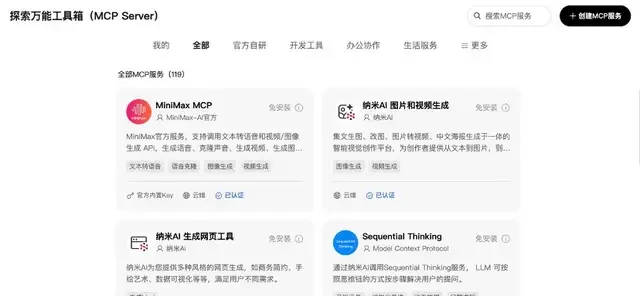
With more MCP tools come more agents built on top of them, fostering a thriving agent ecosystem. Ultimately, Nano AI truly becomes the so-called “universal application.” Of course, that is for the future. For now, openness is the key word observed in Nano AI’s Universal Toolbox.
Looking further, users can construct agents for various scenarios by freely calling and combining MCP tools on top of the Nano AI Universal Toolbox.

The official platform already displays several agents: some are official, others are developed by third parties, and users can also create their own. Notably, many tools that require payment on other platforms are available for free integration and usage on Nano AI.
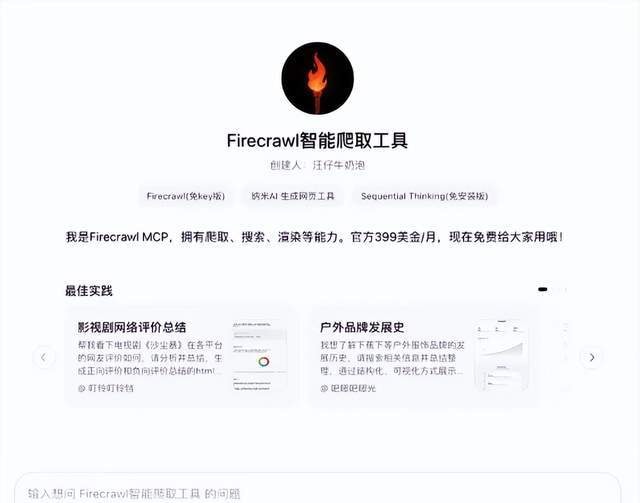
Free, yes!

Given this, let’s conduct a hands-on test.
Deep analysis and research are among the most anticipated skills upgraded in agents. The official platform features a “Deep Research Agent,” so we posed a question to it: The development status of AI glasses products from 2024-2025.
The prompt was simple: provide the query, do nothing else, and there were no buttons for “Web Search” or “Deep Thinking.”
Let’s look at the results.

The output is clear
You can clearly see the entire workflow, from thinking and planning to execution:
Searching for information, generating data visualization icons, and writing research reports.
The process of invoking MCP tools is also transparent, including the sandbox_coder tool generating various icons, the summary tool drafting reports, and the gen_html tool creating web versions…
Finally, it directly provided three versions: PDF, Word, and a webpage, roughly looking like this.
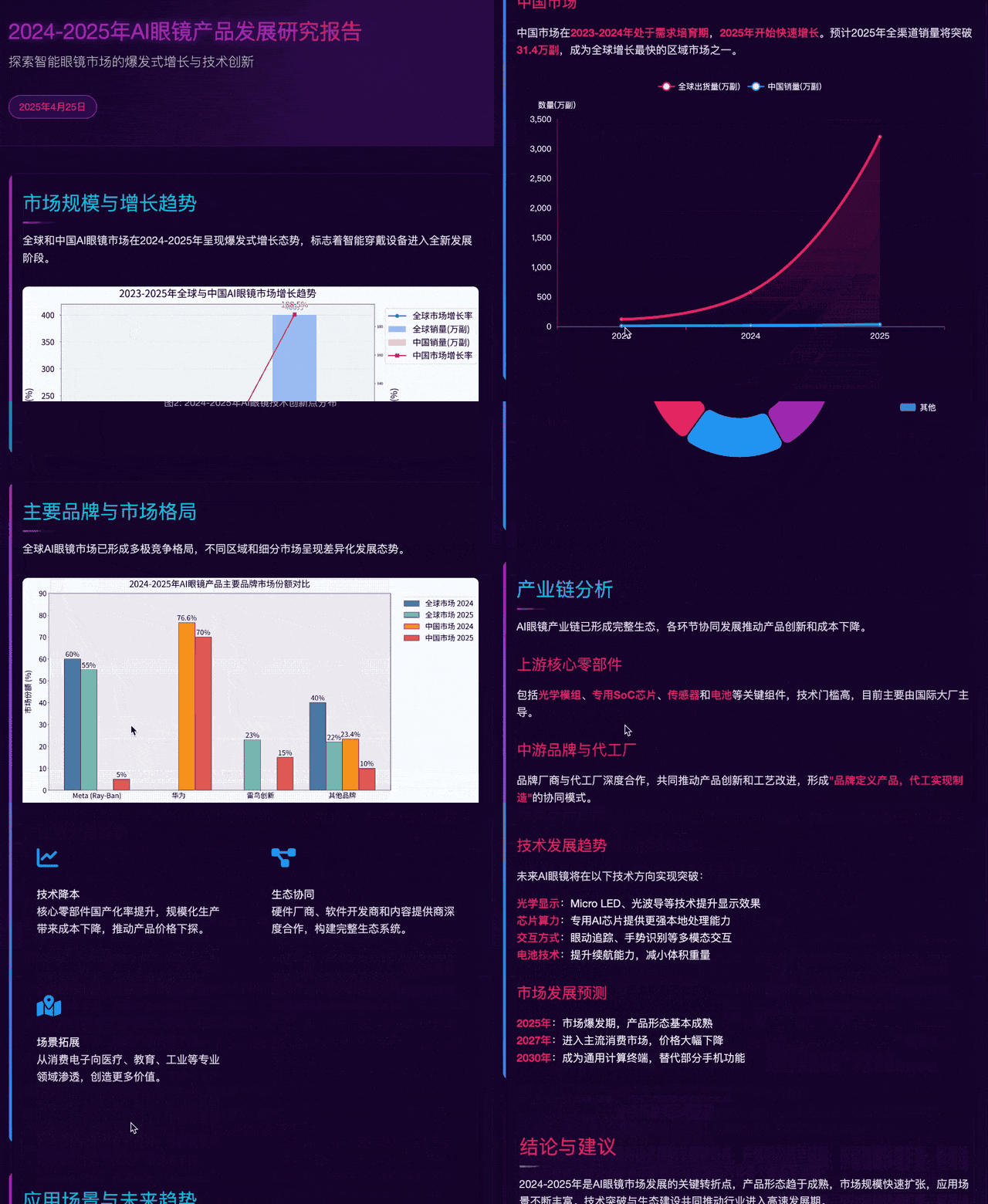
With basic capabilities confirmed, let’s look at other interesting agents empowered by the open MCP ecosystem.
I selected two that particularly impressed me: Xiaohongshu Browsing Bot and Professional Paper Search. Note: Both are developed by third-party developers and can be used for free by ordinary users.
Let’s start with the Xiaohongshu Browsing Bot. The Beijing International Film Festival concluded yesterday, so let’s see how users evaluated this year’s event.
Search and analyze Xiaohongshu users’ evaluations of the Beijing International Film Festival.
Aside from a step requiring manual login, the entire process was smooth. This allowed us to observe its versatile operations.
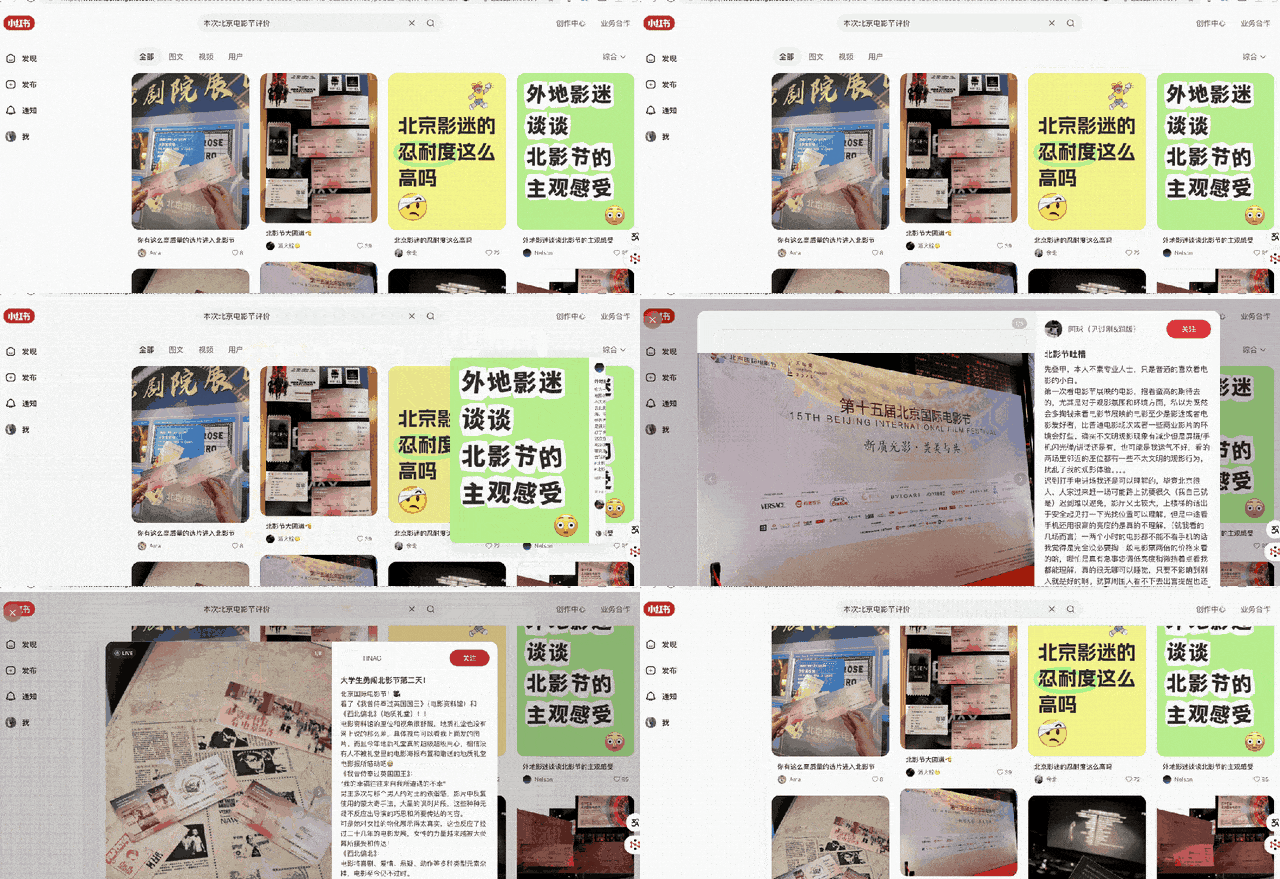
It automatically inputs keywords, clicks through items one by one to view Xiaohongshu posts, and extracts key information. The operation mimics human behavior but achieves higher efficiency—how is that possible?!

From 17 Xiaohongshu posts, it extracted the following key insights. Readers interested in the Beijing International Film Festival might find these resonant~

Furthermore, if you locally set up an automatic Xiaohongshu posting tool, a single command can handle everything from finding trending topics and generating viral content (including images and videos) to publishing. Users can manage their personal self-media accounts on Xiaohongshu with zero intervention.
Next, let’s look at the “Professional Paper Search” agent, which is more relevant to our daily work. This agent can invoke tools such as Nano AI Super Search, arXiv search, Google Scholar, and other academic search engines.
Recently, I needed to communicate with experts in the field of model compression to understand the latest paper developments. So, I posed this question to it:
Help me retrieve the latest hot papers on “model compression,” display the abstract for each, and include links to the papers.
It ultimately provided four papers, complete with titles, abstracts, and direct links.

After verifying each link one by one, I found that all paper links were valid and the papers were published within the last 1–2 months.
This was quite surprising. It means that agents have now overcome the potential hallucination issues inherent in large models, fully achieving a closed loop from understanding to action.
In the past, posing such questions to large models (even with web search enabled) often resulted in invalid links, an inability to understand specific research content, or a failure to adhere to accurate timelines. These problems have now been circumvented.
Beyond official and third-party options, users can also create their own agents tailored to specific needs to invoke various tools.
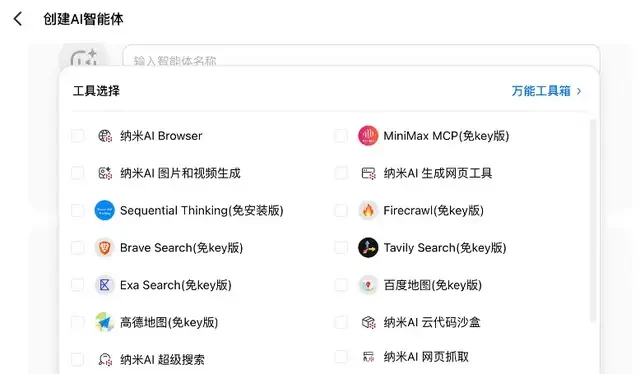
Developers can also configure their own MCP tools/services with just a few parameter settings.

Throughout this process, it is evident that ordinary users find it very convenient to use. With just a single prompt, the agent can automatically analyze user needs, break them down into multiple sub-tasks, autonomously invoke MCP tools (such as browsers and code editors) to execute tasks, and output complete result reports.
The scenarios and capabilities it covers are merely the tip of the iceberg:
According to introductions, the current MCP ecosystem already covers office collaboration, academia, life services, search engines, finance, media and entertainment, data scraping, and other scenarios.
As more MCP tool applications join the platform, the value boundaries of large models and agents will expand infinitely.
Why Choose to Build an Open MCP Ecosystem?
Looking back at MCP now, its impact on the industry is not merely about using a unified standard to allow large models to utilize various tools.
As demonstrated by Nano AI, what MCP brings is a triple breakthrough in technology, functionality, and application scenarios.
Firstly, expanding the functions of large models and Agents has become easier. Developers no longer need to build various interfaces and establish communication methods with external data sources, which can be laborious. However, through the unified MCP (Model Context Protocol) data standard, large language models and AI agents can directly connect to a vast array of external tools, allowing them to combine functionalities freely like building blocks.
Secondly, agents are learning higher-order autonomous thinking; AI is no longer just a robot that follows fixed workflows. Through the MCP protocol, they can proactively acquire information like humans. For instance, they can select necessary functions from an “all-purpose toolbox” (such as checking the weather or writing code), accumulate experience through trial and error, and become smarter with use. Just as interns grow into experts, AI can gradually build its own decision-making systems.
Finally, by freely combining large models with a massive number of MCP tools, complex real-world tasks can be accomplished, significantly broadening application scenarios and truly achieving the concept of ‘the Tao produced One; One produced Two; Two produced Three; Three produced All Things.’ Currently, the Nano AI ecosystem boasts over 100 high-quality, ready-to-use MCP tools and skills that are free to call. Not only does it lead competitors in the number of MCP tools, but it is also simple and easy to use, allowing ordinary users to get started quickly.

For professional developers, this represents the largest and most open MCP tool platform in China. It allows for the free combination of MCP skills to build custom Agent+MCP systems, unlocking new possibilities for agent-based products.
Therefore, when looking at the industry impact brought by MCP, it is not merely about simple tool invocation, but rather providing large models and agent applications with greater potential.
More specifically, this refers to the entire ecosystem of large model applications.
When large models master the ability to use tools and handle complex tasks with ease, their empowerment in the real world will be significantly advanced.
Thus, it is easy to understand why Nano AI chose a product positioning akin to an “all-purpose toolbox”—
To truly anchor itself on the open MCP ecosystem and serve the broad C-end (consumer) user base through simple, low-barrier methods.
However, achieving this reality is no small feat. This requires examining the technological and ecological accumulation behind 360, Nano AI’s parent company.
First is search capability. On one hand, based on the 360 team’s deep historical expertise in search, they have built a hundred-billion-level index library and a billion-level premium content library. On the other hand, by integrating more MCP-compliant search tools—such as Google Scholar, ArXiv, GitHub, and other common utilities—they stack multiple advantages, making their search capabilities increasingly robust.
The effectiveness of the Xiaohongshu browsing assistant demonstrates its strong ability to understand various modalities of page content. This benefits from the deployment of technologies such as SR (Super Resolution), Vision-Language Models (VLM), PDF layout analysis, and OCR models.
Secondly, there is the accumulation of underlying browser capabilities. Unlike cloud-based AI browsers commonly seen elsewhere, they have developed a dedicated browser specifically for large models that runs locally on personal computers.
Why take this approach? Firstly, large models need to invoke browsers frequently; only by comprehensively transforming the cloud, browser, and OS can high-performance, large-scale concurrent invocation be achieved in a cloud-native environment. Secondly, users or enterprises are often reluctant to entrust private data to third-party cloud servers. Furthermore, some enterprise applications operate within intranets where cloud-based agents cannot function effectively. In such cases, local deployment naturally becomes the mainstream choice.
Finally, there is security deployment. They have introduced isolated sandbox MCPs that monitor, warn, and restrict local computer operations by MCP clients in real-time. Users can confidently allow large models to generate commands for local execution without worrying about data loss, information leakage, or high-risk operations caused by hallucinations, errors, or malicious injection attacks.
Currently, Nano AI’s monthly user visits have surpassed 400 million. With comprehensive support for the MCP protocol and increased adoption by more users and developers, a virtuous cycle of product technology is forming, leading to the emergence of even more advanced agents.
Agents Enter the “Point-and-Shoot” Era
It has become a consensus that as large models develop to a certain stage, the next phase of evolution lies in tool usage—specifically, the paradigm shift toward agents.
Analogous to humans, when our bodies and brains evolve to a certain level, we can use tools to interact with all living things and dominate this world. As large model capabilities grow stronger, it is akin to the brain acquiring the ability to think. However, to connect with the real world and translate instructions into actions, tools must be used.
As the connector between large models and tools, “MCP” consensus is gathering globally, sparking an unstoppable wave.
Previously, these developments were largely internal celebrations within the developer and technical communities. Now, represented by Nano AI, the barrier to entry has been significantly lowered, extending agent applications to the general public.
Agents have entered their “point-and-shoot camera” stage. This is actually an inevitable phase in the technology development cycle.
Everyone is talking about super agents now, but when will they arrive?
Perhaps it starts with China’s first truly open MCP ecosystem aimed at ordinary users, or perhaps from the moment straightforward terms like “all-purpose toolbox” replace technical jargon like “MCP.”
In any case, this trend has begun and continues to grow. As the core market application under large models, Agents have truly reached their inflection point for explosive growth.