The creative stack just got a lot less lonely for modelers. VAST’s latest Tripo Studio update doesn’t just generate geometry; it respects the workflow by offering one-click rigging, magic brushes, and intelligent segmentation. This shift from “random mesh generation” to “deliverable results” signals that AI is finally understanding the structural needs of 3D production.
I think one-click rigging removes the tedious manual labor that often stalls indie projects. For creators, intelligent segmentation lets artists swap assets without rebuilding topology from scratch. On licensing, magic brushes offer texture control, reducing reliance on external painting tools. I think these features lower the barrier to entry but may compress rates for junior modelers.
The “Cheat Code” for AI Modeling Has Finally Arrived!
VAST, a prominent startup in the 3D large model space, has significantly upgraded its Tripo Studio with four core features: intelligent component segmentation, texture magic brush, intelligent low-poly generation, and automatic rigging for any object. The overall impression is that AI finally understands modeling. This isn’t an AI that just randomly smashes together a mesh; rather, every feature directly addresses the pain points of traditional modeling workflows.
In the past, creating character models often required outsourcing, involving four-figure quotes and endless rounds of revisions (“tweak until satisfied”), making 3D creation feel like an unattainable dream. Now, large models are landing in 3D modeling applications at a visible speed.
This progress is driven by continuous iteration from players like VAST and open-source foundational models. For instance, TripoSF previously set new state-of-the-art (SOTA) benchmarks, and the latest delivery-ready upgrade of Tripo Studio represents a qualitative shift from “providing models” to “delivering results.”
In practical applications within the CG industry, previous attempts by other 3D generation algorithm tools on the market (including Tripo itself) have generally faced limitations in AI-generated 3D models. Integrating these into industrial pipelines often requires extensive manual adjustments to fit workflow needs.
Tripo Studio, as a one-stop solution, leverages its core advantages—such as topology optimization, intelligent texturing, and component-level editing—to enable output models to directly replace the cumbersome processes of traditional DCC (Digital Content Creation) modeling software in scenarios like game development and industrial design. This achieves end-to-end efficiency improvements from generation to application.
Intelligent Component Segmentation: One-Click Disassembly, Ending the Struggle with Whole-Mesh Editing
The one-click split feature, which users have been clamoring for in comment sections, has finally arrived, serving as a boon for 3D printing and game development users.
The underlying algorithm is Holopart, previously shared as part of Tripo’s open-source monthly toolkit.
While video and image generation models have developed over the past three years, they still face significant limitations in track editing and layer operations. Tripo Studio has pioneered precise, controllable editing within the 3D modality. This breakthrough not only significantly boosts creative efficiency but also opens up vast commercial application spaces.
For 3D printing, Tripo’s intelligent segmentation automatically breaks down models into components, allowing users to assign colors to different areas directly in slicing software. Even four-color PLA printing becomes effortless; there is no longer a need for manual face cutting or topology rebuilding, greatly improving the efficiency and precision of multi-color prints.
For game developers, this feature is equally practical.
Split model components can be retained or replaced as needed. For example, if you upload a humanoid character model and want to change its weapon, you previously had to manually cut faces, pull masks, or even rebuild from scratch. Now, with just one click of “Intelligent Component Segmentation,” the system automatically identifies and splits regions such as the head, body, and limbs, accurately locating even small structures like shoulder pads.
Even better, it allows for manual fine-tuning: if you are unsatisfied with a specific selection, simply use the brush to adjust it. The entire process is shortened from an afternoon to just 20 minutes. For projects requiring frequent character component modifications, rapid equipment swaps, or appearance changes, this feature is a godsend.

Texture Magic Brush: Who Needs Photoshop…?
In the traditional 3D pipeline, UV unwrapping and texture processing remain stubborn bottlenecks. For game character modeling, fixing texture flaws often consumes disproportionate time. Consider a cyberpunk-style character: uneven materials or misaligned textures directly degrade the final visual impact. Manual repair requires repeatedly adjusting UV coordinates—a process that is inefficient and demands high professional skill.
The Magic Brush simplifies this to a “foolproof” level. Previously, creators feared “holes in clothes” or “uneven materials.” Now, you simply lock onto the problematic area and apply one-click automatic repair and stylized texture completion. Paint wherever changes are needed.
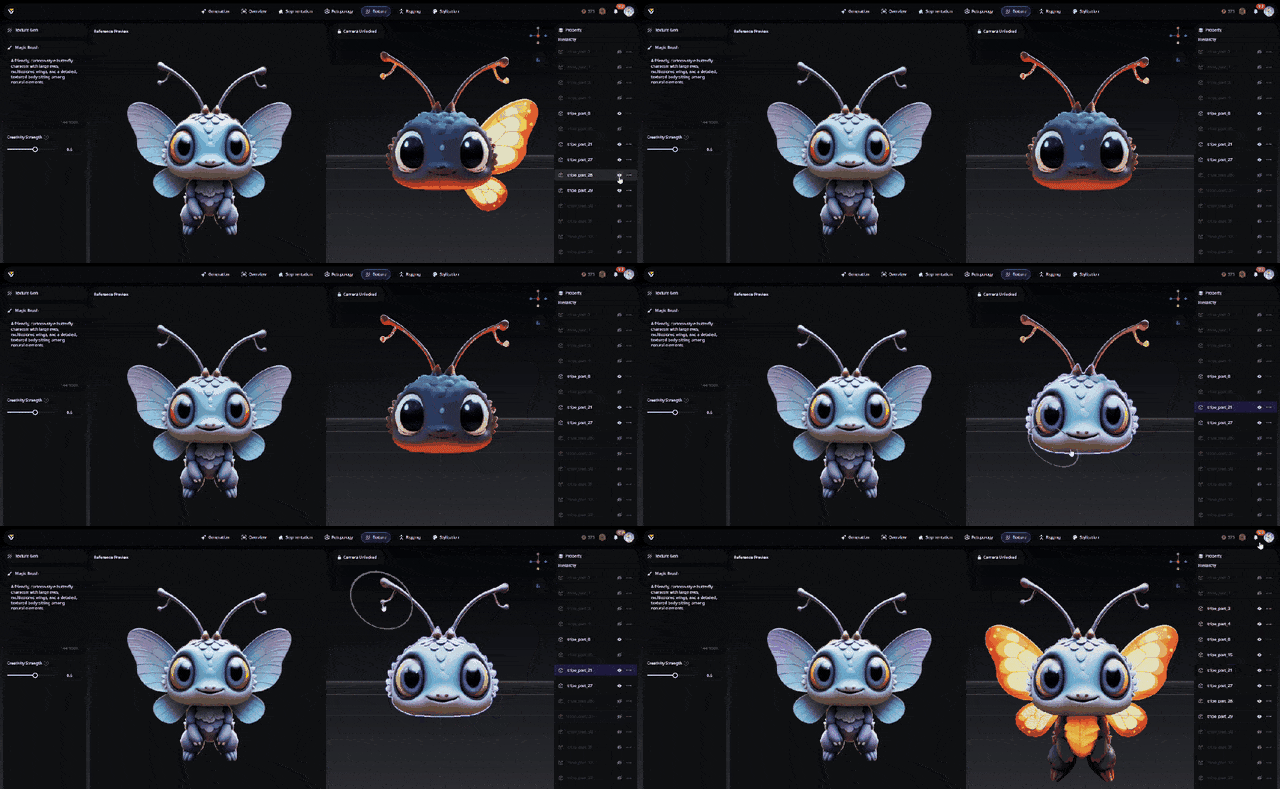
Users only need to select the target area, and the system will quickly complete defect repair while maintaining high consistency in texture style.
What stood out to me is its integration with “Intelligent Component Segmentation.” You can modify specific parts individually—such as changing a character’s face. By selecting the “head” block and lightly painting over the texture, you instantly give the character a new look.
For creators, one-click fixes reduce tedious manual labor for junior artists. On licensing, automated style consistency lowers the barrier to entry for complex texturing.
Intelligent Low-Poly Generation: Tailor-Made for Optimization Struggles
Anyone who builds game models knows the dread of high-poly models freezing like a slideshow upon engine export. In real-time rendering, the conflict between high-fidelity assets and performance bottlenecks is constant. In next-generation game development, such as open-world projects, a single building model often exceeds 100,000 polygons. Even with ultra-high-performance graphics cards, scene loading latency remains high. Traditional optimization requires manual topology decimation—time-consuming, labor-intensive, and prone to texture stretching or structural distortion.
Tripo’s “Intelligent Low-Poly Generation” addresses this directly. After one-click optimization, the system intelligently identifies key model features. It preserves normal map details and UV layout integrity while dropping the polygon count from 100,000 to just 5,000, retaining almost all key details.
Testing showed that frame rates in Unity doubled, making game operation smoother and perfectly balancing visual quality with runtime efficiency.
I think automated decimation saves hours of manual topology cleanup. For creators, preserved UV integrity prevents costly re-texturing after optimization.
No Modeling Skills Needed! VAST Upgrades AI Tool with One-Click Rigging and Magic Brush
Automatic Rigging for Any Object: No More Animation Headaches
Rigging has always been the most time-consuming part of creating character animations. This step has long faced a “digital divide.” In traditional DCC tools like Blender, basic skeletal rigging alone can take animators 8–10 hours. Complex setups, such as inverse kinematics for mechanical structures or muscle system simulations for biological models, often lead to animation glitches and motion distortion.
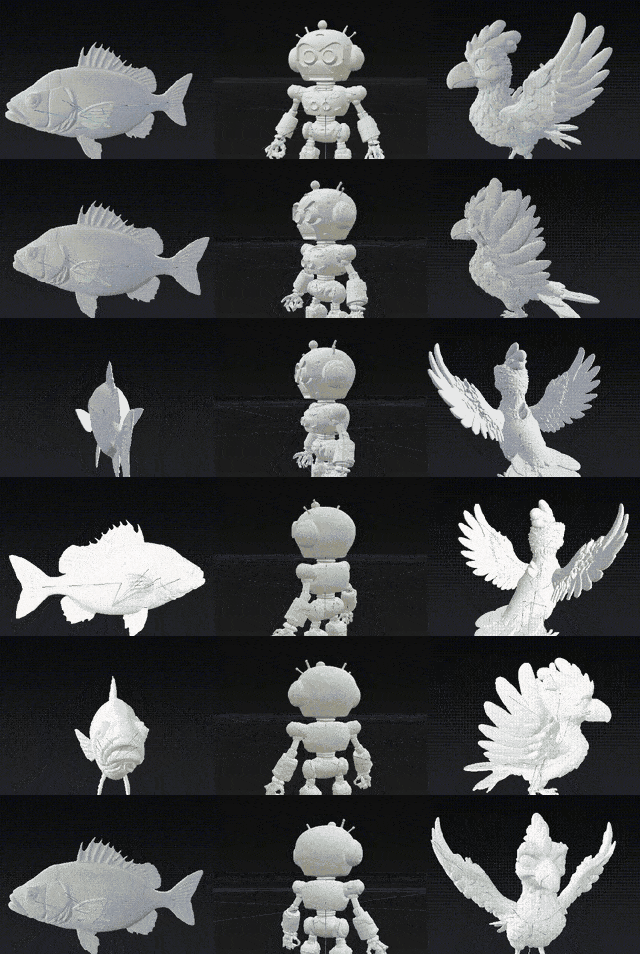
Tripo Studio integrates its proprietary UniRig algorithm, which automatically analyzes the biomechanical features of a model. For example, when a fish model is input, the system accurately identifies key movement dimensions such as fin swing axes and spinal curvature paths, quickly completing skeletal weight assignment and skinning optimization. It supports exporting in mainstream formats like FBX and GLTF.
I read accounts from creators who previously struggled with manual rigging workflows. One creator described spending an entire day manually rigging a mechanical beast model in Blender, only to find the joints moved stiffly, resembling “a robot having cramps.” They ended up abandoning modeling altogether. I followed this sentiment: the friction of technical setup often kills creative momentum before animation even begins.
This time, I read that users fed fish models into Tripo Studio and it automatically recognized the body structure, completing skeletal rigging in just tens of seconds, ready for export in standard animation formats. The key point is: not only humanoids, but insects, fish, birds, and beasts can be rigged smoothly. Animation production efficiency has increased by more than 10 times!
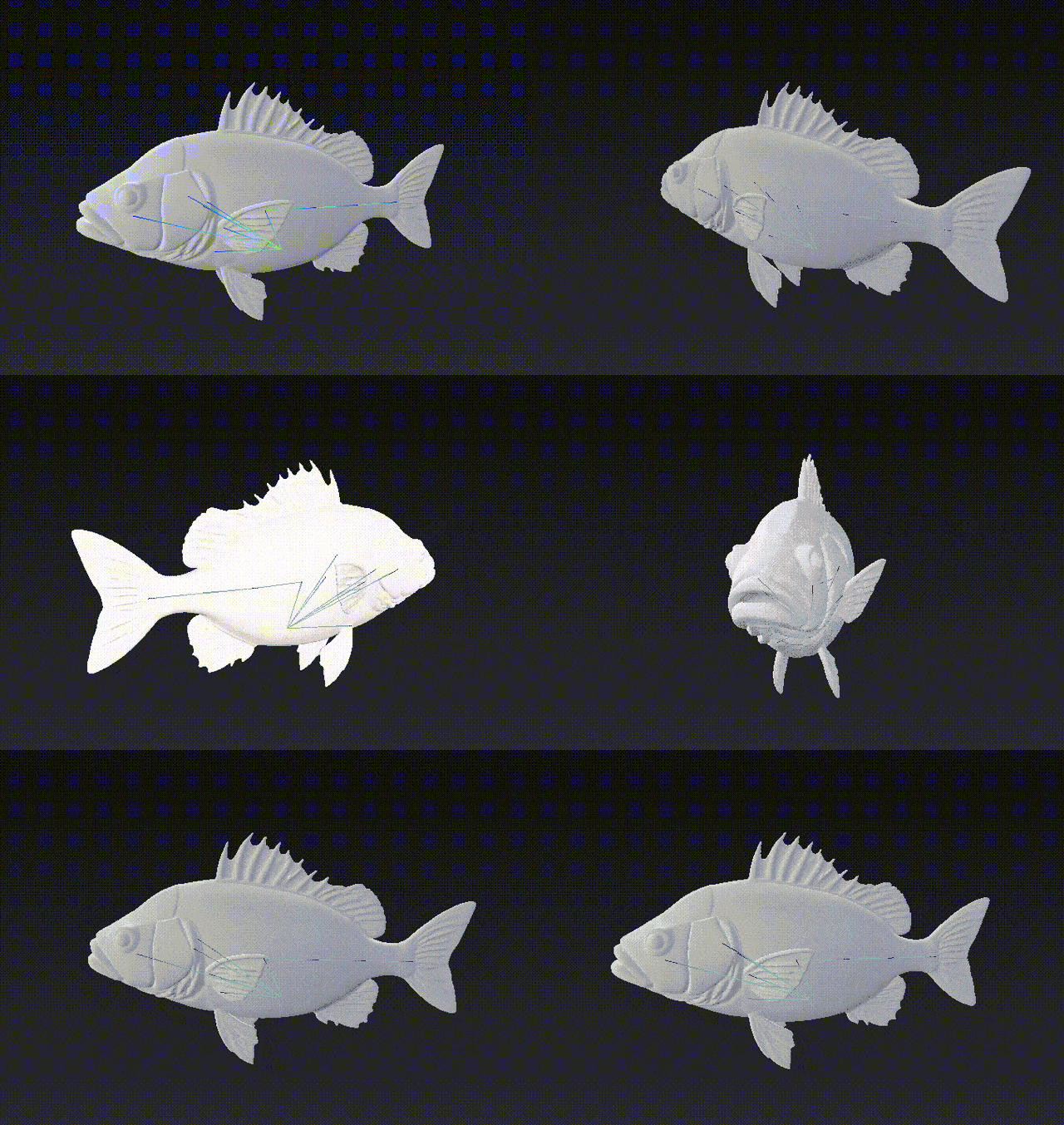
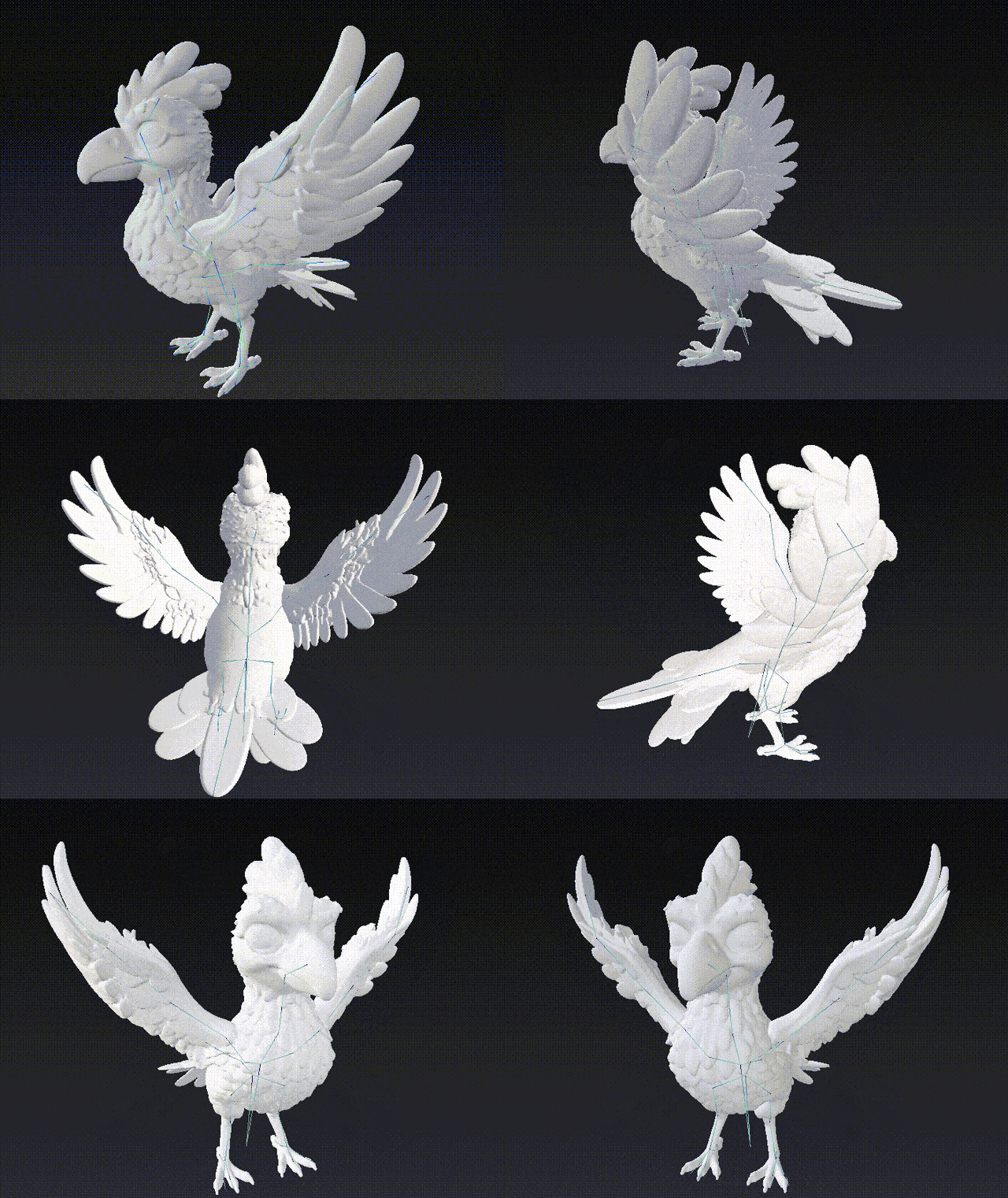
On licensing, rapid auto-rigging lowers the barrier for indie animators to produce professional-grade motion. I think one-click exports reduce technical friction, allowing creators to focus on storytelling rather than topology.
Powered by VAST
Regarding the underlying technology, Tripo Studio is developed by VAST, a star startup in 3D large models. As a leading global provider of 3D generation technology, VAST has always prioritized exploration at the technological frontier. The algorithm suite they recently open-sourced almost entirely integrates into Tripo Studio: including HoloPart and UniRig mentioned above.
We have previously mentioned that the full capabilities of TripoSF would soon be fully realized in the Studio as Tripo 3.0. Let’s look forward to the powerful synergy between top-tier high-poly models and a complete toolset:
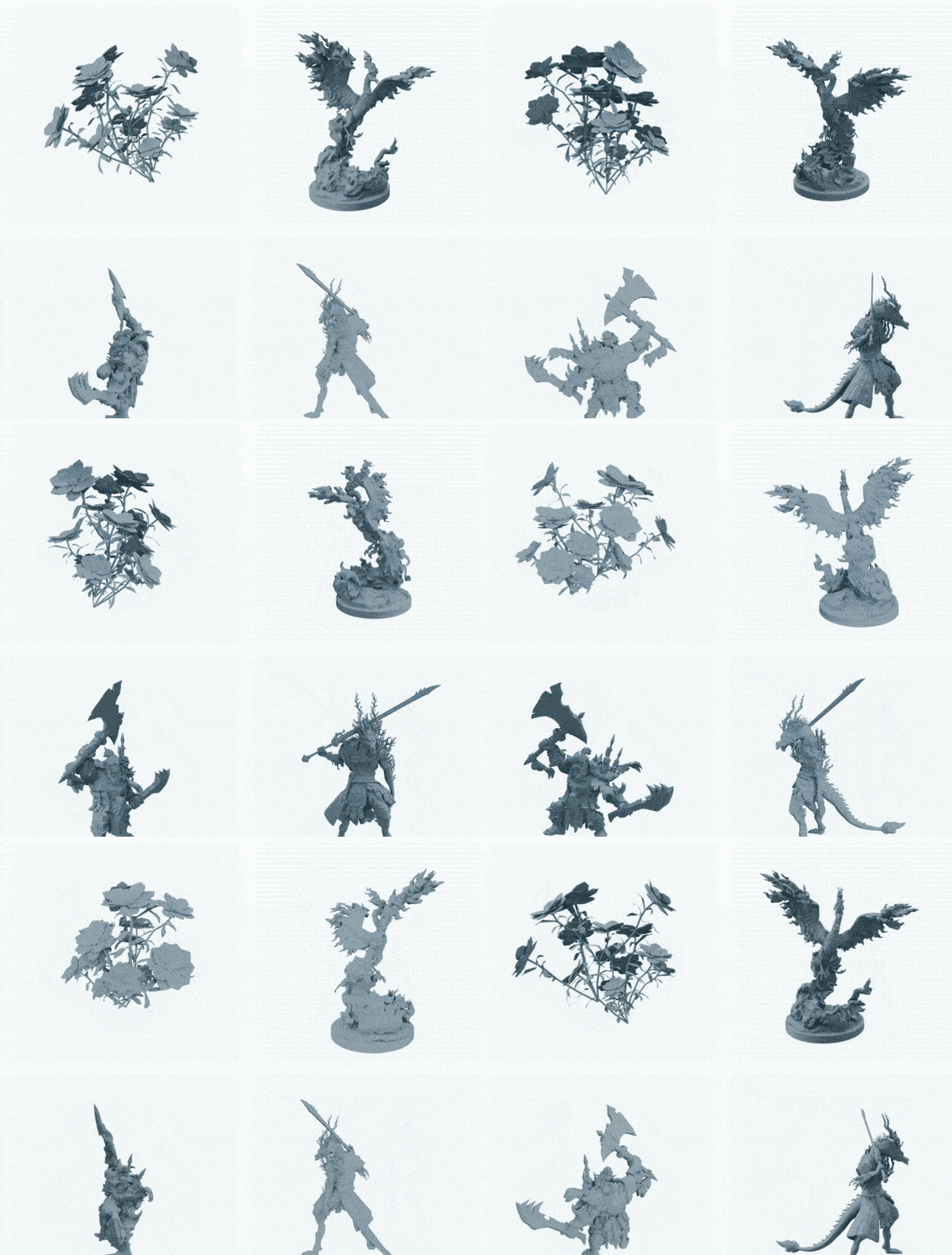
Tripo has been very popular on social media both domestically and internationally. From the “Deepseek + Tripo” trend before the New Year to “GPT-4o + Tripo,” numerous interesting and practically valuable workflows have emerged. Since releasing its algorithm models in early 2024, Tripo has continuously received high praise. Today, thanks to earlier industry insights and know-how, it has redefined the 3D creation pipeline. Every step taken by VAST and the Tripo team has been solid and forward-looking.
Moving from simply providing algorithms to using a complete workstation to capture user intent for 3D creators, experiencing these features reveals that they are not just simple efficiency boosts but “process reengineering.” Traditional 3D modeling requires collaboration among artists, topologists, riggers, and texture specialists. Now, non-professionals can complete the entire workflow through Tripo Studio. This “de-specialization” capability is a core feature of “outcome-oriented products.”
Although VAST’s algorithm team continues to refresh state-of-the-art (SOTA) results in every branch task, what it proves is not just technological progress but also a reconstruction of business logic: In the AI era, the value of a workstation for 3D practitioners no longer depends on “how many high-end tools are used,” but on “how much business output is delivered.”
It was like realizing when I finally deleted the 30GB of traditional plugins from my computer: It wasn’t that I learned 3D modeling; it’s that Tripo Studio made 3D modeling learn to serve me.
For creators, consolidating tools into one platform reduces licensing costs and software fragmentation for small studios. On licensing, de-specialization risks devaluing expert riggers unless new hybrid roles are clearly defined.
Link: www.tripo3d.ai
Comments
Sign in to join the discussion and leave a comment.
Sign in with Google