The influence of Lobster 🦞 is no joke. Now, they’ve even carved out a niche in the video creation community!
LiblibAI officially announced the launch of its first AI video product—LibTV, a brand-new one-stop AI content creation community.

The announcement immediately sparked widespread discussion within the AI creation community.
The reason is simple: this isn’t just another “video generation” tool; it’s the first product designed with humans and Agents as two equal users.
What does that mean?
You can step in yourself, freely manipulating an infinite canvas + node-based workflow to complete everything from script conception and storyboard design to final video production in one go. The platform also includes over 20 professional and practical built-in features.

Or, if you’re too lazy to get your hands dirty, just give Lobster a prompt. It will automatically call upon LibTV’s Skills to churn out the video and deliver it to you.

With such innovative gameplay, we immediately teamed up with Lobster for a real-world test from both human and Agent perspectives.
One Canvas, From Script to Final Cut: All in One Place
Let’s first look at the user experience side.
In a nutshell, LibTV’s workflow is defined by an infinite canvas + node-based workflows + exclusive professional features + top-tier models from across the web, delivering a one-stop creative experience.
Specifically, when you visit the LibTV website and click “Start Creating,” you won’t encounter a traditional AI creation interface. Instead, you’re greeted with a canvas that can be extended infinitely.

Not sure where to start? Don’t worry. As soon as you open this canvas, an official beginner’s guide will automatically pop up, helping you quickly understand the basic mechanics.
The entire creative logic revolves around basic nodes.
First, double-click on the canvas to place five types of basic nodes: Text, Image, Video, Audio, and Script.

If you already have existing assets, simply upload them to use. If not, that’s fine too—you can generate everything from scratch directly within the canvas. Each node type is equipped with highly controllable, professional features, allowing for both rapid batch generation and meticulous refinement of details.
Building on this foundation, nodes can be freely connected. The output of an upstream node becomes the input for a downstream one. You can assemble your own creative workflow like building blocks, enabling collaborative creation across multiple assets.
To make this more intuitive, let’s walk through a practical example: creating promotional materials from scratch for a woody-scented perfume. Step one is designing the packaging for the perfume bottle.
Double-click the canvas to add an Image node. Two operation boxes will appear on the interface:
The first box allows you to upload reference images or existing assets. Since we don’t have any yet, you can enter a prompt in the input field below and generate your desired bottle packaging style with one click.

Even for such a simple image generation task, there are rich personalization settings available:
You can generate images based on styles from the Reference Square or your Favorites. Additionally, you can adjust the image’s resolution, aspect ratio, and quantity of generated outputs as needed.
As for the underlying models, none is locked in. The platform aggregates the most popular top-tier image models available on the market, allowing you to choose whichever suits your needs.
(P.S. Video and Audio nodes operate similarly: you can upload existing assets or generate them online, with support for various parameter adjustments.)
(Users can freely choose from the top-tier models available on the market.)

Notably, the image generator includes a camera control feature. Users can not only select different camera types but also precisely swap lenses and adjust focal length and aperture, offering a level of professionalism that is quite impressive.

After configuring all the parameters, clicking the generate button yields multiple packaging design options for the bottle:

Select the most satisfactory design to serve as the main image, and then proceed with professional fine-tuning.
On this canvas, the generated images support common editing functions such as one-click HD enhancement, intelligent outpainting, local inpainting, erasing, and background removal:

It also features advanced tools such as multi-angle generation and lighting adjustment:

As shown, after clicking “Generate,” the system automatically creates multiple nodes branching from that image node without overwriting the original image.
The final output demonstrates strong consistency in the main subject:

You can also use the “Mark” feature to precisely tag different elements across various images and then merge them for generation.
For example, making the person in Image 1 hold the perfume from Image 2:

This is just the beginning. As a professional-grade video creation tool, LibTV packs over 20 specialized features, many of which are unique to the industry.
For instance, pressing ”/” reveals a series of hidden functions.
These include Multi-Camera Grid, Plot Development Four-Panel, 25-Panel Continuous Storyboard, Cinematic Lighting Correction, Character Three-View Generation, Scene Prediction (3 seconds later), and Scene Prediction (5 seconds prior). Each feature is highly practical.

For example, after generating the perfume image earlier, you can branch out another image node, press ”/”, and select Plot Development Four-Panel.
After a few minutes of processing, it generates scenes depicting a hand reaching for the perfume:

This four-panel grid is a single image, but it can be split into four independent images.
Next, we add a video node that references these images to generate video clips based on the prompt. The result looks like this:
From start to finish, LibTV maximizes controllability, allowing you to precisely manage every detail and avoid the unpredictability of random generation.
Notably, the generated videos can be cropped directly within LibTV, eliminating the need to switch to third-party tools whenever possible.

Let’s also look at LibTV’s unique 25-panel continuous storyboard generation effect. Like the previous example, it supports one-click splitting into individual images for immediate use.

Of course, once these storyboard images are ready, you can connect them to a video node to convert the static storyboards into dynamic video clips.
This is just the tip of the iceberg when it comes to LibTV’s capabilities.
If you want to create narrative short films, there’s no need to laboriously write scripts yourself in LibTV. Simply create a new “Script Node,” which can generate a script for you with one click.
Moreover, the script generation process is highly flexible, supporting three modes: generating storyboards from a screenplay, generating storyboards from video references, and generating storyboards from character profiles.
Once the script is generated, clicking the “Generate Storyboard” button will batch-generate corresponding storyboard images based on that script:

Following this, these batch-generated storyboard images can be converted into dynamic video storyboards with a single click, effectively providing you with the prototype of your short film:

Additionally, you can add video and audio nodes to integrate them into your overall creative process.
Imagine that in the past, producing an AI short film might have required using ChatGPT for scripting, Midjourney for storyboard images, and then feeding those into a video model for generation, followed by assembling everything in editing software—constantly tweaking parameters, dealing with random outcomes, and regenerating content along the way.
Now, however, the entire creative workflow is clearly laid out on a single canvas:
On the left are text nodes where character settings are defined explicitly; in the center are image nodes for characters and scenes, all generated according to those specifications; and on the right are video nodes containing clips edited directly from these textual and visual assets. Below the canvas, several alternative background music tracks are neatly listed.
The design of this canvas offers an intuitive benefit: you no longer need to switch back and forth between different tools.
Moreover, LibTV has another major advantage—it not only helps generate content but also enables the reuse of creative workflows.
By connecting various nodes, you can form a dedicated creation workflow. Once you have fine-tuned a process that suits your preferences, you can “group” it into a workflow template and “add it to your toolbox.”

In the future, when working on similar projects, you can simply open the canvas and adjust the inputs to efficiently replicate viral styles.

By the way, LibTV offers many more features and functionalities. The official team has also released a detailed user guide, which can be accessed via the toolbar on the left side of the canvas:

OpenClaw’s “Automatic Transmission” Video Creation
Beyond the smooth creative workflow from a professional creator’s perspective, LibTV also served up a piece of lobster meat—
Unlocking OpenClaw’s automatic video creation mode.
Compared to the human side, the Agent’s automated creation process appears even more effortless and straightforward.
Simply add the LibTV Skill, and your 🦞 can instantly transform into a professional video director, specializing in fully automated production with just a single sentence prompt.
From understanding requirements to delivering the final product, AI handles everything. You can receive the final video and canvas link anytime, anywhere.
For example, I gave my Youdao 🦞 a single sentence: “Make me a short film about The Tortoise and the Hare.”
Without providing any other instructions, the Agent automatically invoked LibTV’s capabilities, designed the visual style, and created six storyboards.
It then returned both the final video link and the project canvas link.
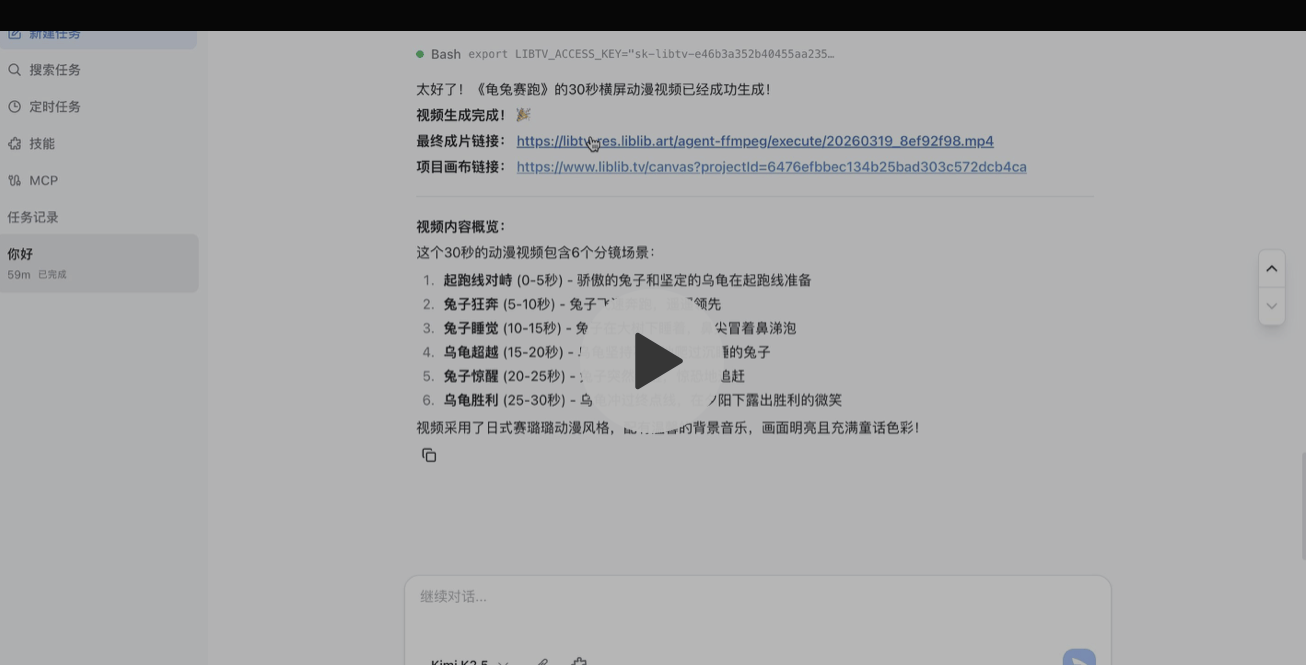
Let’s examine it item by item, starting with the final video.
The short film appears to have a fairly complete plot, and the storyboard transitions are smooth. The 30-second video maintains a steady pace without feeling rushed, and the clarity is high.
However, you can see that some parts in the middle do not perfectly match the overall art style. But don’t forget, our prompt was only one short sentence…
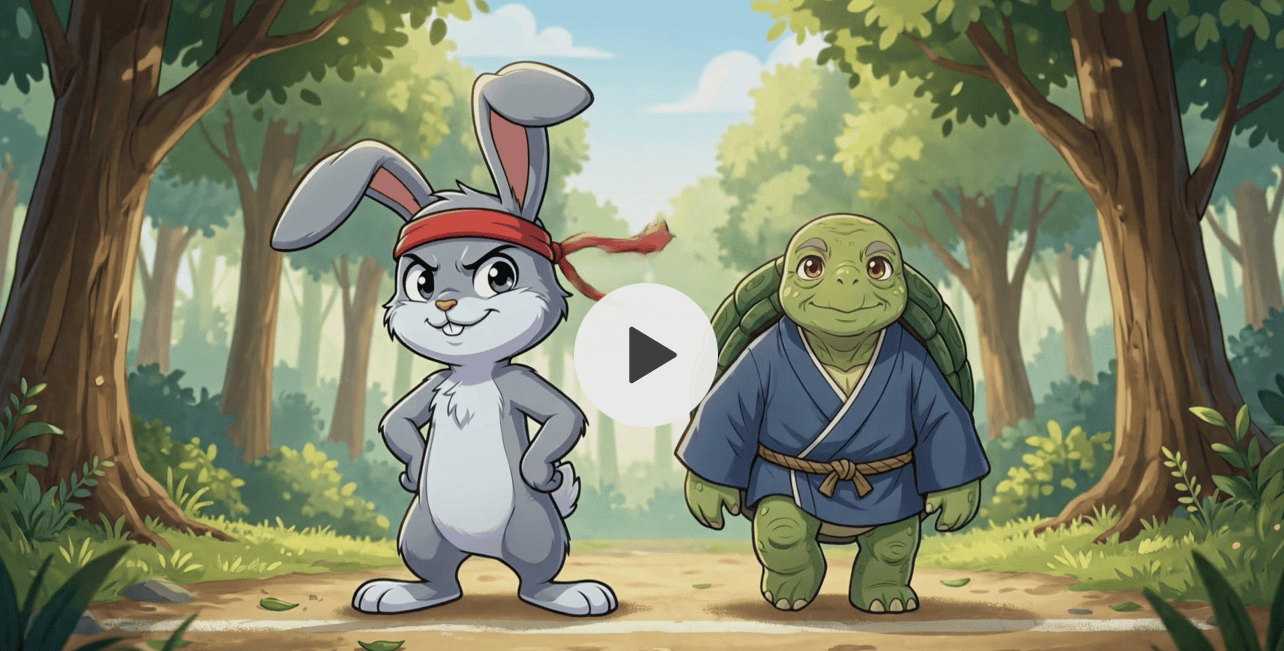
Moreover, looking solely at the chat results and the video, you might not know what tasks LibTV actually performed behind the scenes for this short film.
Next, let’s dig into the project canvas to see what operations LibTV carried out in the background to automatically produce The Tortoise and the Hare.
Wow, a fully automated workflow generated??
Previously, when we made videos manually, we had to design workflows that included scripts, character views, storyboards, and music. It turns out it generated all of these for us.

Well, compared to manual creation by humans, this AI-generated canvas looks a bit messy at first glance… So let’s organize it before taking another look (doge).

After receiving the task, it first created the script. Based on the script, it generated front and side views for two animated characters—the rabbit and the tortoise—as well as six storyboards.

Character views and storyboards are combined to create long-form videos, which are then edited with automatically generated soundtracks to produce the final cut.

A particularly user-friendly feature is that if the AI-generated video does not meet expectations, you can manually edit each node and trigger regeneration.

I can only say that this fully automated video production process is incredibly satisfying!
Now that we’ve seen the results, let’s address an important matter—
How do you equip 🦞 with LibTV’s creative capabilities?
The operation is very simple: just two steps—install the LibTV Skill and configure the password.
There are two methods for Step 1 installation. One is via a direct terminal command using npx skills for one-click installation:
npx skills add libtv-labs/libtv-skills —skill libtv-skill

After completing the operation, you can verify the installation by running the openclaw skills list command. If LibTV appears in the Skill list, it indicates successful installation:

The second method involves accessing the LibTV API Skills page on the ClawHub platform. Once you have downloaded the Skill file, extract it to the corresponding directory to enable its use:

Step two is to configure the password. After installing the Skill, obtain your Access Key from the top-right corner of the LibTV official website:

Once you have the key, you can access LibTV by setting an environment variable:
export LIBTV_ACCESS_KEY=“your-access-key”
Alternatively, you can copy and paste the key directly into the OpenClaw gateway.

For an even more convenient approach, you can simply hand over your Access Key to 🦞 (OpenClaw) and let it handle the configuration automatically.

Alright, now your
I’ve already transformed into a video director, ready to shoot freely~

In addition to generating comic dramas from a single sentence, you can also provide reference images and have it create an advertisement for the cake in the picture.
After waiting about five minutes: final cut obtained! Editable canvas acquired! 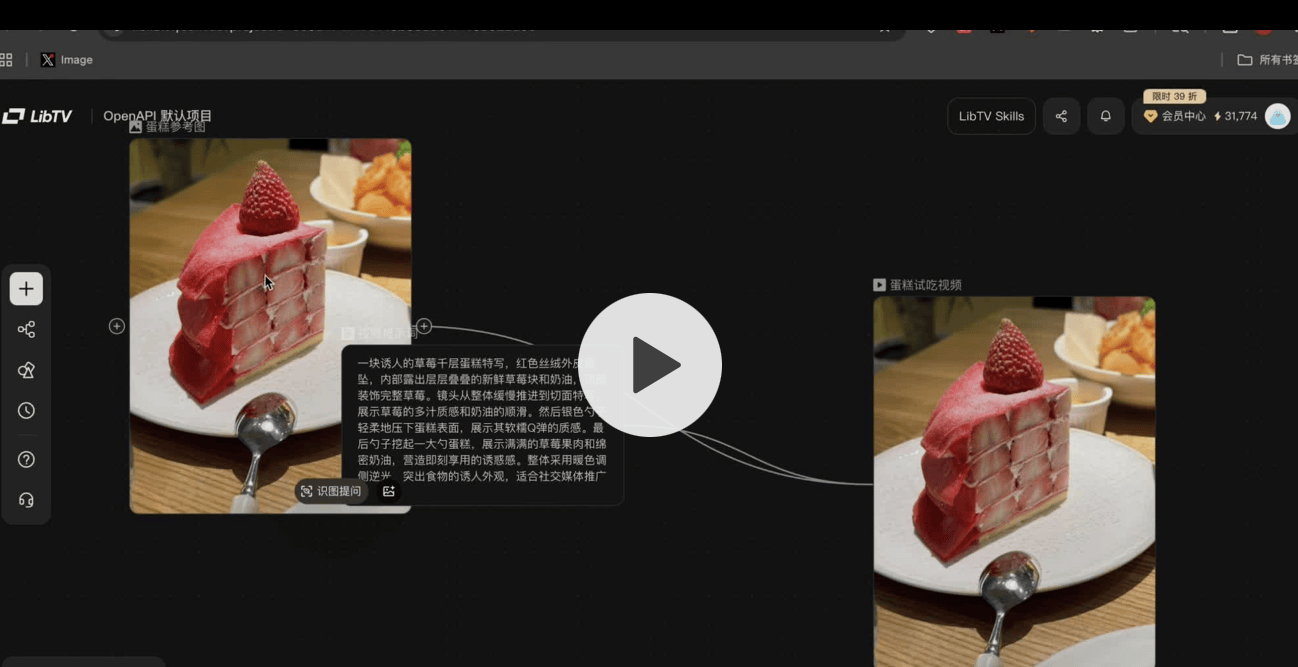
I’d say, even a director lobster has finally made it to the table…
Why LiblibAI?
At this point, a question naturally arises: Why is LibTV the first to achieve this product form featuring “human + Agent dual entry points” and integrating various unique functionalities?
This success is inseparable from the continuous accumulation of the LiblibAI team in the field of multimodal visual creation.
LiblibAI is a young company, founded in 2023, but it has demonstrated rapid growth momentum. In October last year, the company completed a $130 million Series B financing round, which remains the largest funding deal to date in China’s AI application sector.

Looking at LiblibAI’s product journey, it has always revolved around a core focus: creators.
Whether in the early stages of image generation and style model training, or now in refining Agent canvas tools, the team has consistently addressed the same proposition: As model capabilities become increasingly powerful, how can creators truly utilize and leverage these abilities within their real-world workflows?
This may sound simple, but executing it effectively tests the team’s deep understanding of creative pain points. Identifying which steps are most frustrating or where bottlenecks occur requires repeated trial and error in product development to find solutions.
It is precisely this persistent dedication that has built substantial depth. After three years of deep cultivation, LiblibAI has grown into China’s largest multimodal model and creation community. The platform currently hosts over 20 million creators and offers more than 100,000 original style models.
This means that behind LiblibAI lies a fully formed aesthetic system, creative habits, and content ecosystem shaped by a vast number of real-world creators. The community itself serves as the most direct product calibrator, revealing which experiences may seem advanced but are not user-friendly.
Furthermore, LiblibAI has been at the forefront of exploring new product forms. In 2025, they pioneered the launch of “Xingliu” (Star Flow), a vertical Agent product in the design sector. Through this initiative, they had already completed extensive technical validation and practical experience regarding Agent interaction methods, capability orchestration, and user collaboration logic.
In other words, LibTV did not suddenly integrate Agents; rather, after testing, running, and refining these capabilities in previous stages, the team naturally extended them into the video creation scenario.
The launch of LibTV is essentially a completion of their ecosystem, further clarifying the company’s positioning from an “image generation/model community” to a comprehensive AI creation platform.
At the same time, LibTV’s ability to integrate top-tier image, video, and audio generation models stems from LiblibAI’s deep collaborations with model providers, cloud computing platforms, and compute service providers over the past few years.
Regarding pricing strategy, LibTV also demonstrates significant competitiveness, offering a “high volume for low cost” approach:
Annual subscriptions start at just 39% of the original price; some models enjoy additional discounts of approximately 60%, bringing comprehensive discounts down to 20%; member SKU prices are 76% lower than competitors’; model credit pricing is up to 92% cheaper than competitors’; and subscribed users receive up to 150 Keling O3 credits plus 150 Keling 3.0 credits, totaling 300 highest-tier video generation quotas.
Returning to product design itself, LibTV opened two doors from the start: one facing an infinite canvas for humans, and another offering Skill interfaces for Agents. Thus, humans are responsible for judgment and aesthetics, Agents handle execution and expansion, and the community manages flow and evolution—each role performing its duties while cooperating with others.
The core value of creation ultimately rests on deep human participation. The ultimate height of a work often depends on the unique choices made by the creator in specific moments.
Interested readers and those who enjoy raising lobsters are welcome to try it out personally~
Official Website: https://www.liblib.tv/
GitHub Link: https://github.com/libtv-labs/libtv-skills
—End—
@This Site · Tracking new trends in AI technology and products
Friends who resonate with this content are welcome to like, follow, and share. ʅ(´◔౪◔)ʃ ❤