I see a new player entering the high-stakes arena of structural biology AI: GeoFlow. As Enterprise AI & Governance Editor, I track who holds the liability when these models fail or produce unsafe outputs. This release shifts the burden of proof to Biogeo and its scientific advisors to demonstrate that their generative claims are robust, not just marketing hype.
Amid the wave sparked by AlphaFold 3, a new generative AI large model for antibody design has emerged.
Named GeoFlow, it can be used simultaneously for antigen-antibody complex structure prediction and de novo antibody design.
For example, given an antigen structure and a specific epitope, GeoFlow can generate entirely new antibody molecules:
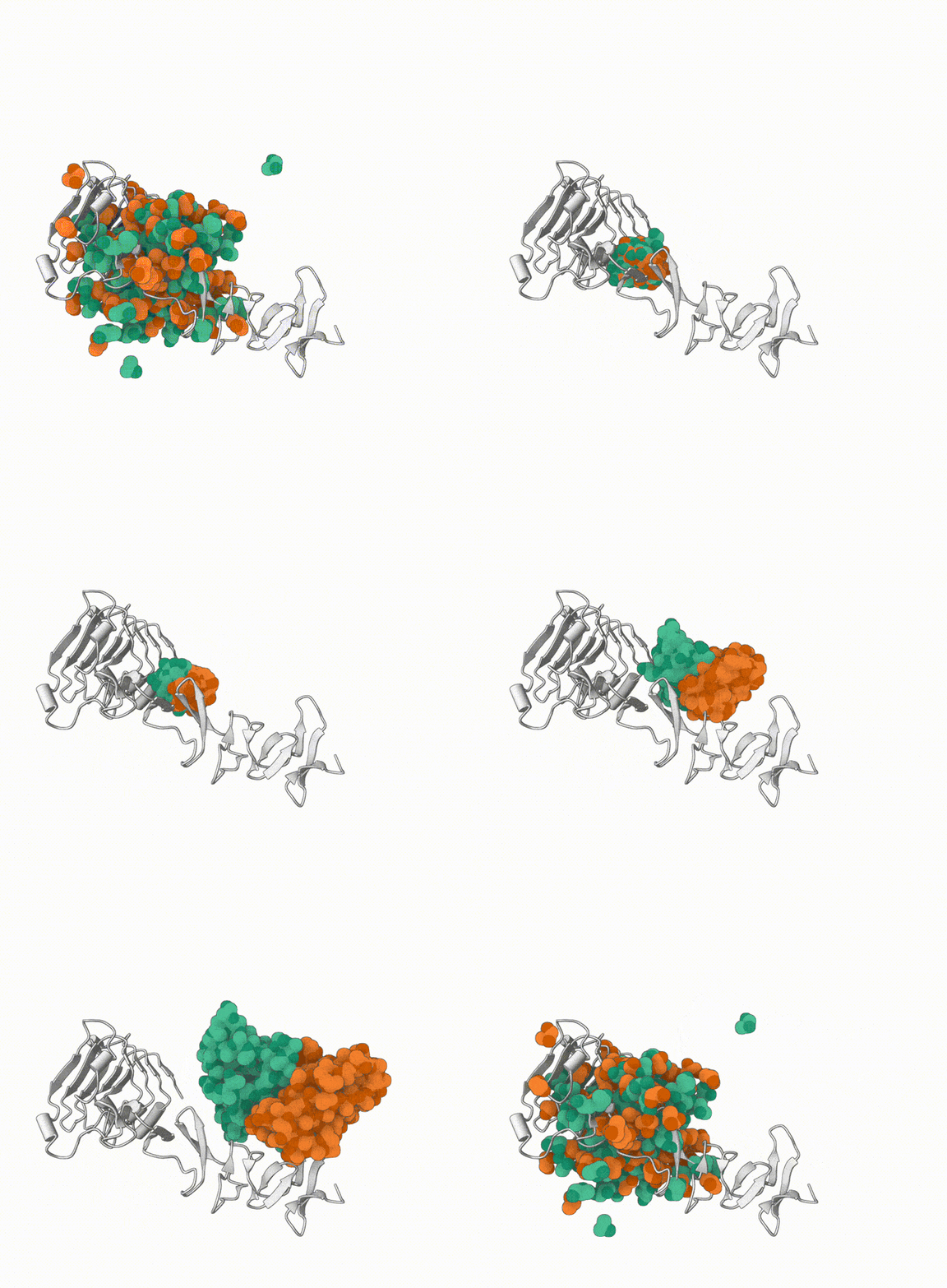
△ Schematic diagram of de novo antibody generation based on GeoFlow
In the task of antigen-antibody complex structure prediction, on a test set consisting of 66 antigen-antibody complex structures, GeoFlow achieved a Top-1 success rate of 43.9%, matching AlphaFold 3.
The GeoFlow R&D team comes from Biogeo, a generative AI-driven protein design and development platform company. Biogeo was founded in 2022 by Dr. Jian Tang, an AI drug discovery scientist, with Yoshua Bengio, one of the “Three Giants” of AI and Turing Award laureate, serving as Chief Scientific Advisor.
What Does GeoFlow Look Like?
I followed the recent publication of AlphaFold 3 in Nature by teams including Google DeepMind and Isomorphic Labs, which drew widespread attention from the industry.
Compared to previous-generation methods, AlphaFold 3 has expanded its prediction scope to almost all biological molecules and their interactions, marking another important milestone for generative AI in the life sciences.
One of the model’s key innovations is the use of a popular generative AI technique—the diffusion model (whereas AlphaFold 2 was a discriminative AI model)—to directly generate the 3D coordinates of each atom.
If traditional discriminative AI is like a music critic who can identify and evaluate a song’s rhythm, style, and arrangement, then generative AI is like a singer who can create new works.
From evaluating data to generating data, the application scenarios for AI have been greatly expanded. For instance, in structure prediction tasks, generative AI can sample more conformations faster; in protein design tasks, it can explore protein space more efficiently to design complex protein molecules with intended functions.
Diffusion generative models were initially used primarily for image generation (recently also applied to 3D video generation, such as Sora).
I read that the core team at Biogeo began applying diffusion models to the 3D structure generation of molecules in 2021. Their paper on GeoDiff was among the top 50 most cited papers in AI in 2022.
Building on this technical foundation, they have developed the latest generative AI large model for antibody design: GeoFlow.
The GeoFlow model architecture is as follows:
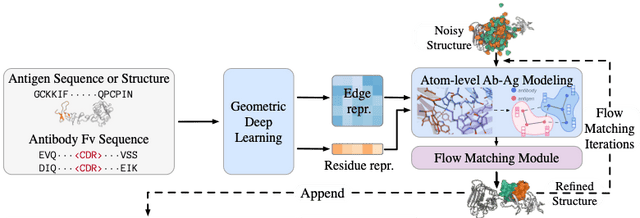
GeoFlow is based on a geometric deep learning architecture and the latest flow matching generative model. It can be used simultaneously for:
- Antigen-antibody complex structure prediction: Inputting antigen structures/sequences and complete antibody sequences, the model generates the antigen-antibody complex structure.
- Antibody design: Inputting antigen structures and antibody sequences, with the CDR regions to be designed represented as masks, the model generates the complex structure and the CDR region sequences.
Modeling antigen-antibody interaction forces at the atomic level is the core difficulty in these two tasks.
Unlike existing Transformer architectures, GeoFlow adopts a geometric deep learning foundation model, which better models atom-to-atom relationships in three-dimensional space.
Regarding generative model selection, GeoFlow employs the latest flow matching model. Compared to diffusion generative models, flow matching models are more efficient and robust during both training and inference.
Domestic Generative AI Model for Antibody Design Matches AlphaFold3, Predicts Antigen-Antibody Complex Structures and Enables De Novo Antibody Design
Antigen-Antibody Complex Structure Prediction Rivals AF3
I read the performance metrics closely because accuracy in this domain is not just a technical stat—it’s a compliance gatekeeper for drug discovery. The research team evaluated GeoFlow’s capability on antigen-antibody complex structure prediction, a task that remains suboptimal for traditional energy-function methods like HDock and MOE, as well as deep learning models such as AlphaFold 2 Multimer.
On a test set of 66 antigen-antibody complex structures published after 2023, GeoFlow’s Top-1 success rate reached 43.9%. I note that this metric is defined as successful if the DockQ score of the highest-ranked structure is “Acceptable” or above. This result matches AlphaFold 3 and approximately doubles the performance of AlphaFold 2 Multimer.
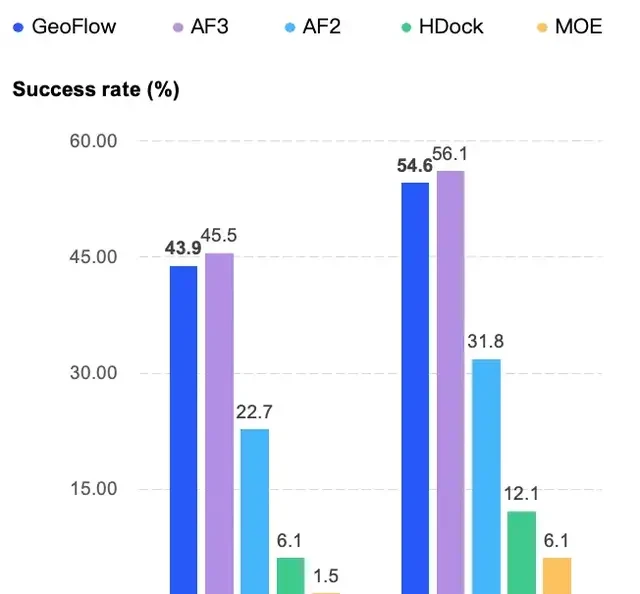
△ Evaluation results for antigen-antibody complex prediction
I followed the comparison with traditional molecular docking methods, which can generate multiple structures but suffer from low scoring accuracy. This limitation restricts their practical application value in a regulated environment where predictability is paramount.
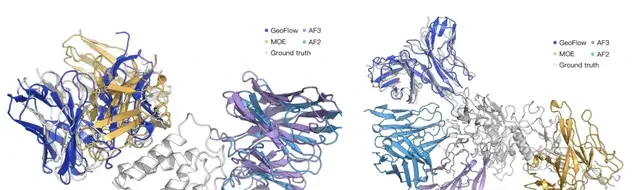
△ Comparison of prediction results by various models for PDB 8BLQ (left) and 8DOK (right)
What stood out to me is that GeoFlow extends beyond prediction into de novo antibody design and optimization. For traditional AI, designing large molecules is difficult due to the challenge of sampling high-quality samples from an immense molecular space—a process akin to finding a needle in a haystack. Generative AI offers a revolutionary opportunity here, shifting the burden from discriminative evaluation to generative creation.
Taking the HER2 target as an example, I reviewed how the team used GeoFlow to generate a small antibody library based on Herceptin’s binding epitope. They screened this using a phage display library and obtained ten candidate sequences with notable results:
- Binding Activity: Six molecules showed binding comparable to Herceptin in ELISA experiments, reaching nanomolar levels. BLI results indicated that the affinity of molecule #1 and #3 was 2-3 times higher than that of Herceptin.
- Binding Epitope: Competitive ELISA showed strong competition between these six molecules’ binding and Herceptin, suggesting their binding epitopes are consistent with those of Herceptin.
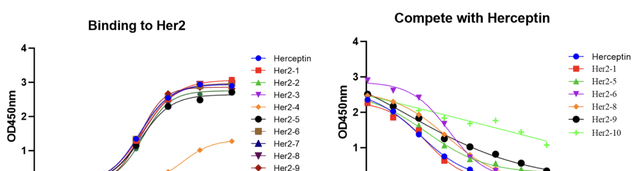
These results demonstrate the application prospects of generative AI in de novo large molecule design. However, enterprises must verify that these early-stage successes translate to reproducible, audit-ready pipelines before integrating them into clinical workflows.
I think a 43.9% success rate is promising but still leaves significant room for error in high-stakes drug discovery. My sense is enterprises should demand full transparency on the DockQ scoring thresholds used in this validation set. What concerns me is that the 2-3x affinity improvement for specific molecules warrants independent replication before commercial reliance.
About Biogeo
I looked into the governance structure of Biogeo, a generative AI-driven protein design platform founded by AI scientist Dr. Jian Tang in 2022. Yoshua Bengio, known as the “Father of AI” and Turing Award laureate, serves as Chief Scientific Advisor. This high-profile advisory role suggests significant technical ambition but does not absolve the company of operational accountability.
The company’s business focuses on building AIGC large models to understand the language of life. They aim to create multimodal large models that bridge natural language and protein language, reconstructing antibody drug discovery and design processes. Their generative AI large models currently cover stages such as large molecule design, screening, and modification, including GeoBiologics, a one-stop antibody discovery platform.
The GeoFlow model is currently open for non-commercial testing of antigen-antibody complex structure prediction, supporting eight predictions per week with an input limit of 1,150 amino acids per task.
Test address:
I observed that the current access is strictly limited to non-commercial testing. This restriction places the burden of proof on researchers to validate these models before any commercial deployment can be considered compliant with regulatory standards.
I think the non-commercial limit protects Biogeo from liability but delays enterprise-grade validation for potential partners.
Comments
Sign in to join the discussion and leave a comment.
Sign in with Google